Softmaxxing vs Hardmaxxing: What's the Difference?
Softmaxxing is what you do yourself; hardmaxxing is what a professional does to you. Where the line falls, what each side changes, and which to start with.

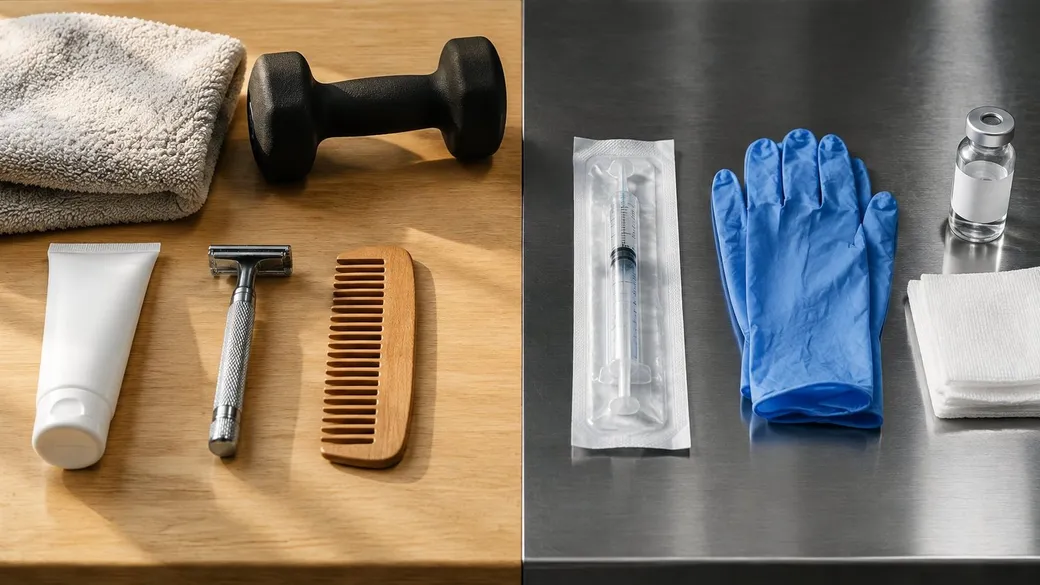
Softmaxxing is improving your looks with changes you make yourself and keep up, like skincare, sleep, training, grooming and style. Hardmaxxing is procedures a qualified professional does to your body, from injectables, which wear off over months, to surgery, which is permanent. The test is who does it, and whether it stops when you stop.
The difference between softmaxxing and hardmaxxing is who does the work. Softmaxxing is everything you do yourself and keep up: skin, sleep, training, grooming and style. Hardmaxxing is a procedure a professional does to your body, and its result outlasts your effort, for months with an injectable and for good with surgery.
In practice, the community starts soft. In our survey of forum members, about three in four groomed, trained and watched their diet, while 3% had had surgery.
Softmaxxing vs hardmaxxing at a glance
| Softmaxxing | Hardmaxxing | |
|---|---|---|
| What it is | Habits, products and grooming | Injectables, then surgery |
| Who does it | You | A qualified professional |
| How long it lasts | As long as you keep it up | Months for injectables, permanent for surgery |
| Size of change | Real, within the structure you have | The largest: it changes the structure itself |
| Risk | Low | Real, and greatest with surgery |
Where the line falls
The line falls between what you do yourself and what a professional does to your body. Guides online disagree about the middle: fillers and Botox count as hardmaxxing on most of them and as softmaxxing on others, and almost nobody places braces. Two questions settle nearly every case:
- Who does it? You, or a professional working on your body.
- Does it stop when you stop? If it lasts only while you keep it up, it’s soft.
A prescription sits on the soft side: you take it yourself, but a doctor decides whether you should and manages it.
| Change | Side | Why |
|---|---|---|
| Skincare and sunscreen | Soft | You do it daily |
| Training and losing body fat | Soft | You keep it up |
| Haircut, grooming, beard | Soft | No procedure |
| Teeth whitening | Soft | Tooth shape unchanged |
| Prescription skin or hair medicine | Soft, with a doctor | A doctor prescribes it |
| Braces or aligners | Hard | An orthodontist moves your teeth |
| Laser hair removal | Hard, at the mild end | A professional treats your skin |
| Botox | Hard, temporary | Wears off in about four months[1] |
| Filler | Hard, temporary | Often lasts one to two years[2] |
| Hair transplant | Hard, permanent | A surgeon moves follicles |
| Nose or jaw surgery | Hard, permanent | A surgeon changes bone or cartilage |
Surgeons file Botox and filler as nonsurgical procedures, separate from operations.[3] The community still counts them as hardmaxxing, because someone else does them to your body, and that’s the line this guide uses.
What softmaxxing changes
Softmaxxing changes how lean, healthy and rested you look, and each of these has rating research behind it:
- Body fat, in the face too. Faces carrying less fat were rated healthier and more attractive,[4] and a review found a robust link between facial fat and both.[5] The body fat calculator gives you a number to track.
- Even skin and sunscreen. Our skinmaxxing guide ranks every skincare step by its evidence. In men, more even skin color was rated younger, healthier and more attractive.[6] In a randomized trial, daily sunscreen for four and a half years left skin aging about 24% lower than using it when people felt like it.[7]
- Sleep. After 31 hours awake, the same people were rated less attractive and less healthy,[8] and a night without sleep showed most around the eyes, the area our hunter eyes guide covers.[9]
- Training. Resistance training added about 1.5 kg of muscle on average in healthy adult men,[10] and in men’s bodies, the waist-to-chest ratio was the main driver of how women rated them.[11] The shoulder-to-waist ratio calculator measures your side of that.
- Grooming. Beards were rated more attractive than clean-shaven faces for long-term relationships, though not short-term ones.[12]
What hardmaxxing changes
Hardmaxxing is where the biggest changes are. It’s the only way to change bone and cartilage or move a hairline, and its results hold without daily effort. Softmaxxing works within the face you have; a procedure changes the face itself.
- Injectables are temporary and mostly low-risk in experienced hands. Botox reduced wrinkles within four weeks but probably raised the risk of a drooping eyelid.[13] At one large clinic group, serious complications from filler happened in about 4 of every 100,000 injections.[14]
- Hair transplants last: 85 to 93% of transplanted grafts survived, depending on technique.[15]
- Surgery changes bone and cartilage permanently. Satisfaction after aesthetic surgery climbed from about 71% at one month to 92% at a year.[16] In a small study, after jaw surgery for an underdeveloped upper jaw, patients were rated more attractive, friendlier and more trustworthy from their photographs.[17] Our guides to the gonial angle and a flat maxilla cover what jaw surgery can and can’t move.
Procedures carry real risk and recovery, so choose a qualified, board-certified surgeon or injector. A good one will also ask why you want it: about one in five people asking for cosmetic surgery has body dysmorphic disorder,[18] and patients screened first were more satisfied afterward.[16]
What the looksmaxxing community actually does
Mostly softmaxxing. Our community survey asked 175 forum members in March 2025 what they had tried:
- Grooming: 78.7%
- Fitness: 75.9%
- Diet: 75.3%
- Non-surgical procedures: 9.2%
- Surgery: 3.4%
Interest runs the other way: 49.1% were considering surgery and 42.9% non-surgical procedures. Softmaxxing is what three in four already do, and hardmaxxing is what about half are thinking about.
Which should you do first?
The general consensus in the looksmaxxing community is to softmax first, then hardmax what’s left. Soft changes cost little, still lift how you’re rated, and change what a surgeon would be working with: a face carrying less fat looks different before anyone touches it.
But softmaxxing has a ceiling. It can’t move a jaw, reshape a nose or rebuild a hairline. For structural features, hardmaxxing is the only route, and it’s where the largest changes happen.
What counts as neither
Bonesmashing, unprescribed drugs and mewing count as neither:
- Bonesmashing is a dangerous online trend of deliberately striking the face to try to alter bone. It is injury, not a technique, and nothing supports it.
- Unprescribed drugs, peptides and steroids sold online for looks have no place on either side. Anything that changes your hormones or skin pigment is a decision for a doctor.
- Mewing is a posture habit, not a bone treatment. No trial shows it moves the jaw.
Frequently asked questions
What does hardmaxxing mean?
Hardmaxxing means changing your looks through procedures a qualified professional does to your body. It runs from injectables like Botox and filler, which wear off, to permanent changes like braces, hair transplants and nose or jaw surgery.
Do braces count as hardmaxxing?
Yes, by the usual test: an orthodontist moves your teeth, and the change is meant to last. Braces are often a dental treatment first.
Is Botox softmaxxing or hardmaxxing?
Hardmaxxing, at its temporary end. Surgeons class it as nonsurgical,[3] but someone else injects it, and it lasts about four months.[1] Filler sits beside it and often lasts one to two years.[2]
What is a softmaxxing routine?
Daily sunscreen and a simple skincare routine, enough sleep, resistance training, losing body fat if you carry extra, a haircut that suits your face, grooming and clothes that fit. Dermatologists usually reassess skincare at two to three months; training takes longer.
Is hardmaxxing worth it?
For structural features, it’s the only thing that changes them, and satisfaction a year after aesthetic surgery runs above 90%.[16] Getting the softmaxxing done first means you know exactly what’s left to fix.
References
- [1] Glogau, R., Kane, M., Beddingfield, F., et al.. OnabotulinumtoxinA: a meta-analysis of duration of effect in the treatment of glabellar lines — Dermatologic Surgery , 2012 . ↩
- [2] de Castro Costa, M., Andrade, C. A., Dantas, R. V. F., et al.. Clinical Durability of Hyaluronic Acid-Based Dermal Fillers for Facial Application: A Systematic Review — Aesthetic Plastic Surgery , 2026 . ↩
- [3] Triana, L., Palacios Huatuco, R. M., Campilgio, G., et al.. Trends in Surgical and Nonsurgical Aesthetic Procedures: A 14-Year Analysis of the International Society of Aesthetic Plastic Surgery-ISAPS — Aesthetic Plastic Surgery , 2024 . ↩
- [4] Coetzee, V., Perrett, D. I., & Stephen, I. D.. Facial adiposity: a cue to health? — Perception , 2009 . ↩
- [5] de Jager, S., Coetzee, N., & Coetzee, V.. Facial Adiposity, Attractiveness, and Health: A Review — Frontiers in Psychology , 2018 . ↩
- [6] Fink, B., Matts, P. J., D'Emiliano, D., et al.. Colour homogeneity and visual perception of age, health and attractiveness of male facial skin — Journal of the European Academy of Dermatology and Venereology , 2012 . ↩
- [7] Hughes, M. C., Williams, G. M., Baker, P., et al.. Sunscreen and prevention of skin aging: a randomized trial — Annals of Internal Medicine , 2013 . ↩
- [8] Axelsson, J., Sundelin, T., Ingre, M., et al.. Beauty sleep: experimental study on the perceived health and attractiveness of sleep deprived people — BMJ , 2010 . ↩
- [9] Sundelin, T., Lekander, M., Kecklund, G., et al.. Cues of fatigue: effects of sleep deprivation on facial appearance — Sleep , 2013 . ↩
- [10] Benito, P. J., Cupeiro, R., Ramos-Campo, D. J., et al.. A Systematic Review with Meta-Analysis of the Effect of Resistance Training on Whole-Body Muscle Growth in Healthy Adult Males — International Journal of Environmental Research and Public Health , 2020 . ↩
- [11] Maisey, D. S., Vale, E. L. E., Cornelissen, P. L., & Tovée, M. J.. Characteristics of male attractiveness for women — The Lancet , 1999 . ↩
- [12] Dixson, B. J., Sulikowski, D., Gouda-Vossos, A., et al.. The masculinity paradox: facial masculinity and beardedness interact to determine women's ratings of men's facial attractiveness — Journal of Evolutionary Biology , 2016 . ↩
- [13] Camargo, C. P., Xia, J., Costa, C. S., et al.. Botulinum toxin type A for facial wrinkles — Cochrane Database of Systematic Reviews , 2021 . ↩
- [14] Tamura, T., Tamura, T., Okumura, K., et al.. Serious Complications of Hyaluronic Acid Fillers-A Retrospective Study of 290,307 Cases — Annals of Plastic Surgery , 2025 . ↩
- [15] Stoneburner, J., Shauly, O., Carey, J., et al.. Contemporary Management of Alopecia: A Systematic Review and Meta-analysis for Surgeons — Aesthetic Plastic Surgery , 2020 . ↩
- [16] Friedman, O., & Tal, D.. Temporal satisfaction patterns in body image after aesthetic surgery: A systematic review and meta-analysis — Journal of Plastic, Reconstructive & Aesthetic Surgery , 2025 . ↩
- [17] Posnick, J. C., & Kinard, B. E.. Orthognathic Surgery Has a Significant Positive Effect on Perceived Personality Traits and Perceived Emotional Facial Expressions in Subjects with Primary Maxillary Deficiency — Plastic and Reconstructive Surgery Global Open , 2019 . ↩
- [18] Salari, N., Kazeminia, M., Heydari, M., et al.. Body dysmorphic disorder in individuals requesting cosmetic surgery: A systematic review and meta-analysis — Journal of Plastic, Reconstructive & Aesthetic Surgery , 2022 . ↩
Related articles
Skinmaxxing: What It Is and What Actually Works
Skinmaxxing is improving your skin on purpose. The routine, every common step ranked by the evidence behind it, and how long each one takes to work.

Flat Maxilla: How to Tell and What Changes It
What a flat maxilla is, how it differs from a recessed one, how to tell from your profile, and what actually changes it at every age.
Gonial Angle: What's Normal and How It's Measured
What a normal gonial angle is, what's considered attractive, and why the number from a selfie or face app isn't the one doctors measure.