Hunter Eyes: What They Are & Can You Get Them?
What hunter eyes are, how they differ from prey eyes, and whether you can get them. The research backs an upward tilt and a low brow, but not extra lift.

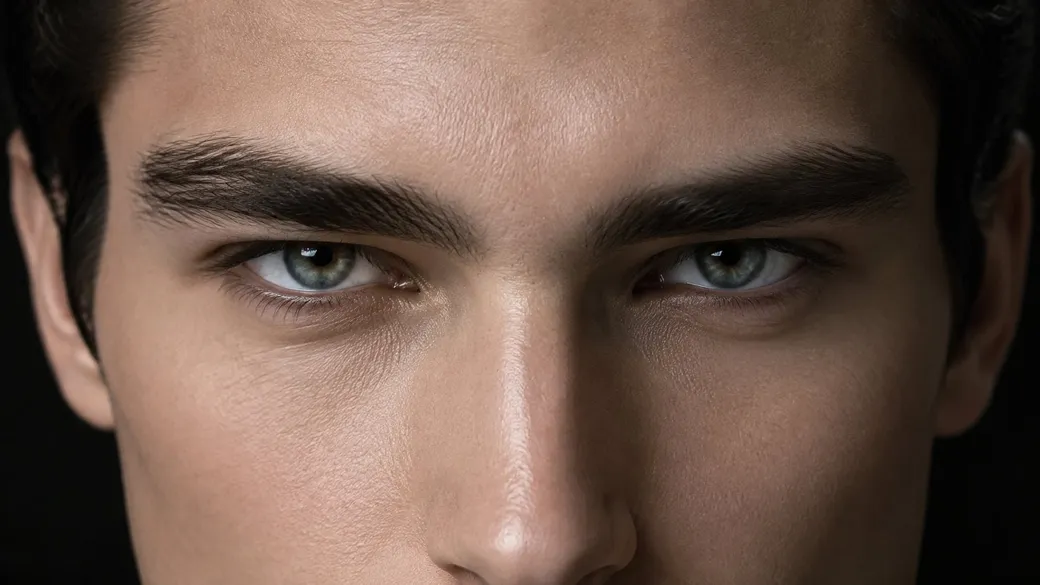
Hunter eyes is community shorthand for deep-set eyes with a positive tilt and little visible upper eyelid. The look comes from four features: canthal tilt, eye depth, upper eyelid exposure and brow position. Bone and eyelid anatomy set most of it. An upward tilt goes with attractiveness in real faces, but adding lift to a face rated lower.
The general consensus in the looksmaxxing community is that the more of the hunter eyes look you have, the better you look. The research backs part of that. In real faces, the more attractive had the more upward tilt.[1] What didn’t help was adding more: raising the brow or lifting the outer corner both made faces rate lower.[2]
What the research says about hunter eyes
In real faces, an upward tilt is a plus. In two of three studies, the more attractive group had the more upward tilt.[1][3]
What the research doesn’t back is adding more. A 2025 study edited one unisex face into nine versions and had 2,081 adults rate each one.[2] Raising the outer corner of the eye, the lateral canthus, lowered ratings for attractiveness, masculinity and trustworthiness. It raised ratings for dominance, threat and disgust. Male and female raters agreed on all of those, and only split on femininity.
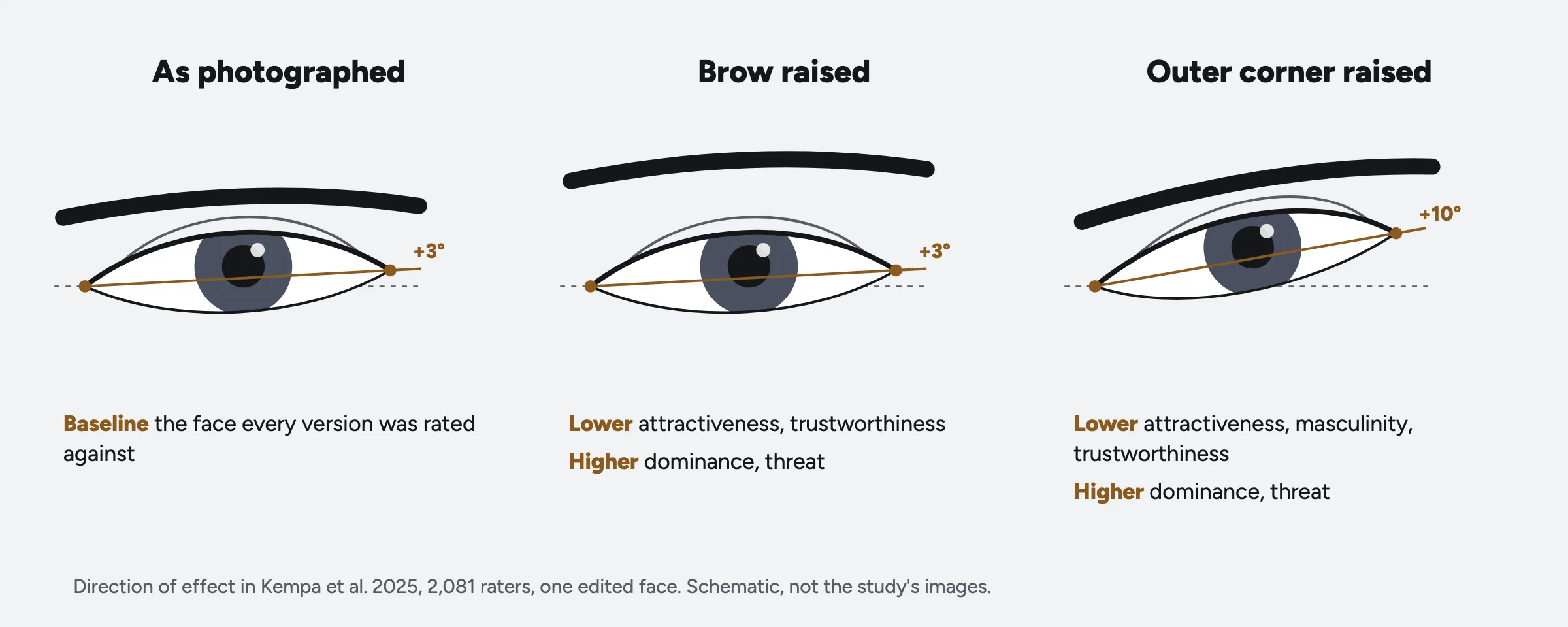
That’s a direct test of the “more is better” part of the claim, and it doesn’t hold: lifting the corner past where it sat made the face look harder, not better or more masculine.
A second 2025 study from the same group points the same way. When 50 raters looked at faces with exaggerated edits, raising the outer corner “sharply reduces the attractiveness in male and female faces”. When edits were combined, the eye change drove most of the drop.[4]
How far to trust it. All four are single studies, graded B under our evidence standards. The real-face studies compared groups rather than testing a change, and the two 2025 experiments used one edited face and deliberately exaggerated changes. Read together: an upward tilt goes with attractiveness, and adding lift beyond a face’s own doesn’t help, which is the opposite of how the tilt gets ranked online.
The 93% figure is about something else
A study showing a 93% preference gets quoted as proof that tilt drives attractiveness. It’s real, but it tested women’s faces, and the angle it changed was the inner corner of the eye, not the outer one.[5] Judges picked the edited face 93% of the time. It says nothing about men or about the outer corner, which is the part hunter eyes is about.
The features that make up the look
Hunter eyes isn’t one measurement. It’s four features at once, and they don’t all behave the same way.
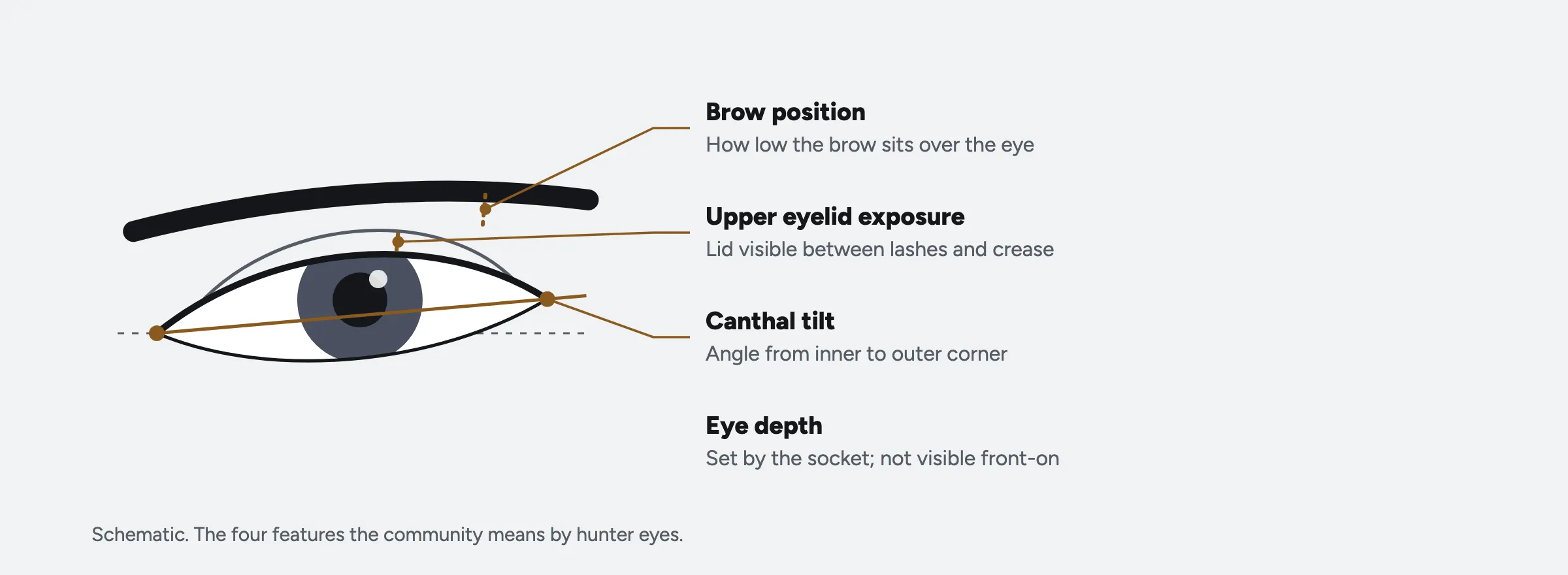
| Feature | Can you measure it? | What changes it |
|---|---|---|
| Canthal tilt, the angle from inner to outer corner | Yes, in degrees | Surgery only. Head angle changes how it reads in a photo |
| Deep-set eyes, how far back the eye sits | Not from a front-on photo | Bone. Fixed in adults without surgery |
| Upper eyelid exposure | Roughly, from a photo | Sleep changes how the lid hangs. Ptosis can be treated |
| Brow position | Roughly, from a photo | Brow lifts raise it, and a raised brow rated lower in the 2025 study |
UEE is upper eyelid exposure, how much of the eyelid is visible when the eye is open. Of the four, it’s the one that sleep visibly changes.
Hunter eyes vs prey eyes
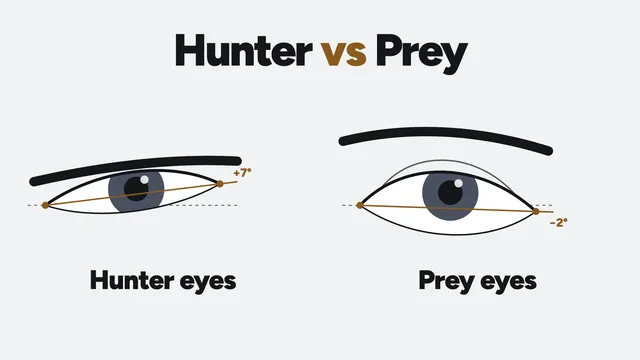
Prey eyes is the community’s contrast term for rounder, more exposed eyes. The research splits the two by feature: the upward tilt favors hunter eyes, while open, larger eyes rate well too, especially in women. Our hunter eyes vs prey eyes guide goes through each feature, in men and in women.
Are hunter eyes genetic?
The parts that define the look are anatomy. How deep the eye sits is set by the bone of the eye socket. The tilt is set by where the corners of the eyelids are anchored to bone. Neither changes in an adult without surgery.
That still leaves room to move. The eyelid and the skin around the eye change with sleep, and those are the parts the next section is about.
What changes the eye area without surgery
Sleep is the lever with the clearest evidence. In a study published in the BMJ, people photographed after 31 hours awake were rated less attractive, less healthy and more tired than after a normal night.[6] The attractiveness drop was small, 38 against 40 on a 100-point scale, but it was consistent.
A follow-up from the same lab found where it shows. Sleep-deprived faces had more hanging eyelids, redder and more swollen eyes, and darker circles underneath.[7] Those are exactly the features hunter eyes turns on: how the lid sits, and whether the area looks puffy or clean.
If you’re short on sleep, that’s the change here with measured results behind it, and it costs nothing.
Does mewing give you hunter eyes?
There’s no evidence that it does. We searched PubMed on September 24, 2026, and found four papers about mewing itself. None of them was a trial, so nobody has tested whether it changes the eye socket, the tilt or anything else.
That isn’t proof it does nothing. It means the claim has never been checked. Mewing is a posture habit, not a bone treatment, and our interview with Dr Mike Mew covers what its main proponent actually argues for.
Measure your own canthal tilt
The one hunter-eyes feature you can put a number on is the tilt. The canthal tilt calculator reads both eyes from a photo, in degrees, and it runs on your own device.
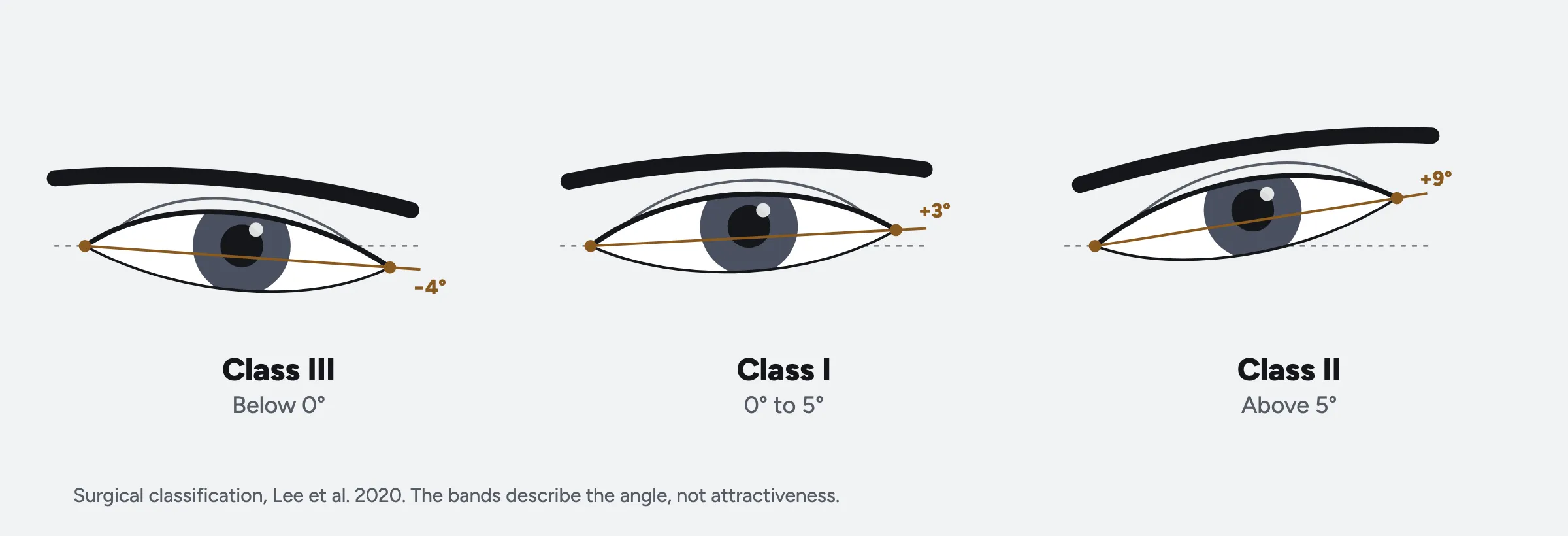
To read the result, surgeons use a published classification: 0° to 5° is class I, above 5° is class II, and below 0° is class III.[8] In the surgical series behind it, 76 patients with a mean age of 23, most fell in class II, with a mean of about 9.5°. That’s one clinical sample, so treat it as a reference point and not a target. The 2025 studies are the reason not to chase extra lift with surgery.
Hold the camera level with your eyes. Tipping your head back or down changes how the tilt reads.
What hunter eye surgery involves
Hunter eye surgery is a label for eyelid and eye-corner procedures. It’s for adults, and it’s a decision for a qualified surgeon. The specialists are oculoplastic surgeons, eye doctors with extra training in plastic and reconstructive surgery.[9]
- Eyelid lift (blepharoplasty): removes loose skin and fat from the eyelids, and can include ptosis repair.[10]
- Ptosis repair: fixes an upper lid that droops over the eye. In more severe cases the muscle that lifts the lid is shortened and reattached.[11]
- Canthal procedures: change the position of the outer eye corner. This is the change the 2025 studies tested, and exaggerated lifts rated lower, not higher.[4]
The risks listed for eyelid surgery include dry eyes, blurred or double vision, trouble closing the eyes during sleep, uneven scarring, eyelids that don’t match, and, rarely, damage to the eye or loss of vision. Bruising can last two to four weeks.[10] A drooping lid that has changed recently is a reason to see an eye doctor either way.
Frequently asked questions
Are hunter eyes attractive?
Partly. In real faces, the more attractive group had the more upward tilt,[1] and in the largest study a raised brow lowered attractiveness ratings, which fits the low-brow part of the look. But lifting the outer corner past its natural position lowered attractiveness and masculinity, and made the face read as more threatening.[2] An upward tilt helps. More lift doesn’t.
Can you get hunter eyes naturally?
Not the bone or the tilt, which are set in adults. You can change how the eye area looks day to day. Sleep loss adds hanging lids, puffiness and dark circles, and the same faces showed less of all three after a normal night.[7] Neither mewing nor eye exercises has been tested in a trial.
Do women have hunter eyes?
The features are the same in any face, and the term is used for both. The 2025 study found men and women rated a raised outer corner the same way: lower on attractiveness, higher on threat.[2] Only the femininity ratings split by the rater’s sex.
Is a negative canthal tilt bad?
There’s no direct evidence either way, because none of the studies included faces with a natural negative tilt. In real faces, the more attractive group had the more upward tilt, so positive has the edge.[1] The canthal tilt calculator will tell you which way yours runs.
What is a good canthal tilt?
There’s no evidence-backed ideal, and normal canthal tilt differs by population. Surgeons classify 0° to 5° as class I and above 5° as class II, and one surgical series averaged about 9.5°.[8] Raising the outer corner beyond a face’s natural position lowered ratings in the 2025 studies.[2]
References
- [1] Patel, A. A., Garg, S. P., Wan, R., et al.. Periorbital Measurements of Attractiveness in Young Black Women: An Anthropometric Approach — Journal of Craniofacial Surgery , 2026 . ↩
- [2] Kempa, J., Kasielska-Trojan, A., Gabryszewski, M., et al.. Understanding the impact of eyebrow and lateral canthal height on the perception of character traits: A rating-based analysis of 2081 participants — Journal of Plastic, Reconstructive & Aesthetic Surgery , 2025 . ↩
- [3] Sforza, C., Dolci, C., Grandi, G., Tartaglia, G. M., Laino, A., & Ferrario, V. F.. Comparison of soft-tissue orbital morphometry in attractive and normal Italian subjects — The Angle Orthodontist , 2015 . ↩
- [4] Kempa, J., Kasielska-Trojan, A., Antoszewski, B., et al.. Measuring the effects of facial regional changes following excessive aesthetic treatments: A survey and eye-tracking-based investigation — Journal of Plastic, Reconstructive & Aesthetic Surgery , 2025 . ↩
- [5] Bashour, M., & Geist, C.. Is medial canthal tilt a powerful cue for facial attractiveness? — Ophthalmic Plastic & Reconstructive Surgery , 2007 . ↩
- [6] Axelsson, J., Sundelin, T., Ingre, M., et al.. Beauty sleep: experimental study on the perceived health and attractiveness of sleep deprived people — BMJ , 2010 . ↩
- [7] Sundelin, T., Lekander, M., Kecklund, G., et al.. Cues of fatigue: effects of sleep deprivation on facial appearance — Sleep , 2013 . ↩
- [8] Lee, J., Choung, H., & Choung, P.. Diagnostic analysis of vertical orbital dystopia and canthal tilt for surgical correction — Journal of the Korean Association of Oral and Maxillofacial Surgeons , 2020 . ↩
- [9] Oculoplastic procedures — MedlinePlus, US National Library of Medicine , 2024 . ↩
- [10] Eyelid lift — MedlinePlus, US National Library of Medicine , 2025 . ↩
- [11] What Is Ptosis? — American Academy of Ophthalmology , 2026 . ↩
Related articles
Hunter Eyes vs Prey Eyes: Which Is More Attractive?
Hunter eyes vs prey eyes, feature by feature: what each label means, what the research says is more attractive in men and in women, and how to measure yours.
Canthal Tilt: What's Normal and What's Attractive
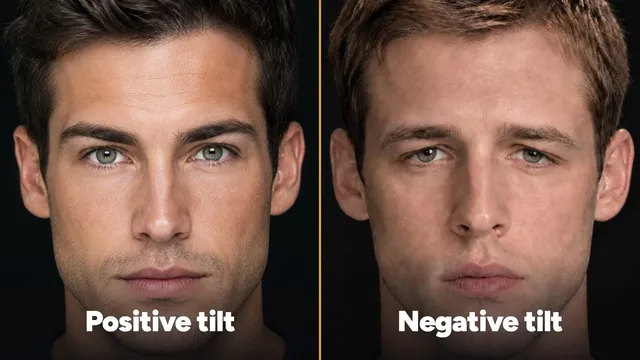
What canthal tilt is, what's normal, and whether positive really beats negative. In rated photos, the most attractive faces had the most upward tilt.

Skinmaxxing: What It Is and What Actually Works
Skinmaxxing is improving your skin on purpose. The routine, every common step ranked by the evidence behind it, and how long each one takes to work.