Canthal Tilt: What's Normal and What's Attractive
What canthal tilt is, what's normal, and whether positive really beats negative. In rated photos, the most attractive faces had the most upward tilt.

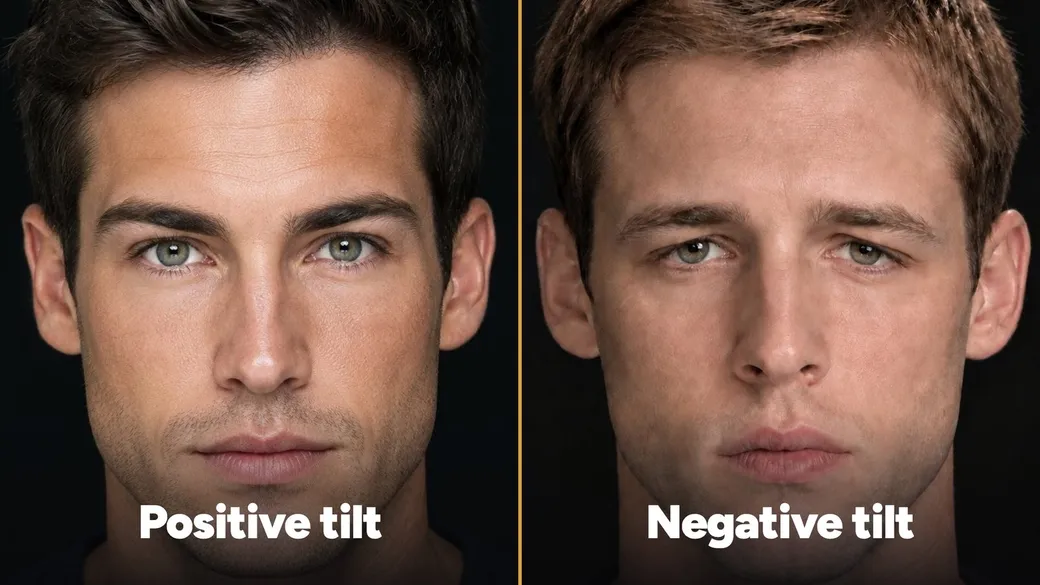
Canthal tilt is the angle of the line from the inner corner of the eye to the outer corner, measured against horizontal. Positive means the outer corner sits higher, and negative means it sits lower. In the published studies, every group of adults averages a positive tilt, from about 1° to 10° depending on who was measured.
A positive canthal tilt is treated as the attractive one, and the research backs that up: in rated photos of real faces, the most attractive had the most upward tilt.[1] It has a limit. When researchers lifted the outer corner past where it naturally sat, raters scored the face lower, not higher.[2]
Your own reading is also less fixed than it looks. The same eyes went from clearly upturned to nearly level in one study, just by moving the chin.[3]
Positive, neutral and negative canthal tilt
The inner corner of the eye is the medial canthus, and the outer corner is the lateral canthus. The tilt is the angle of the line between them.
- Positive: the outer corner sits higher than the inner one.
- Neutral: the two corners are level.
- Negative: the outer corner sits lower.
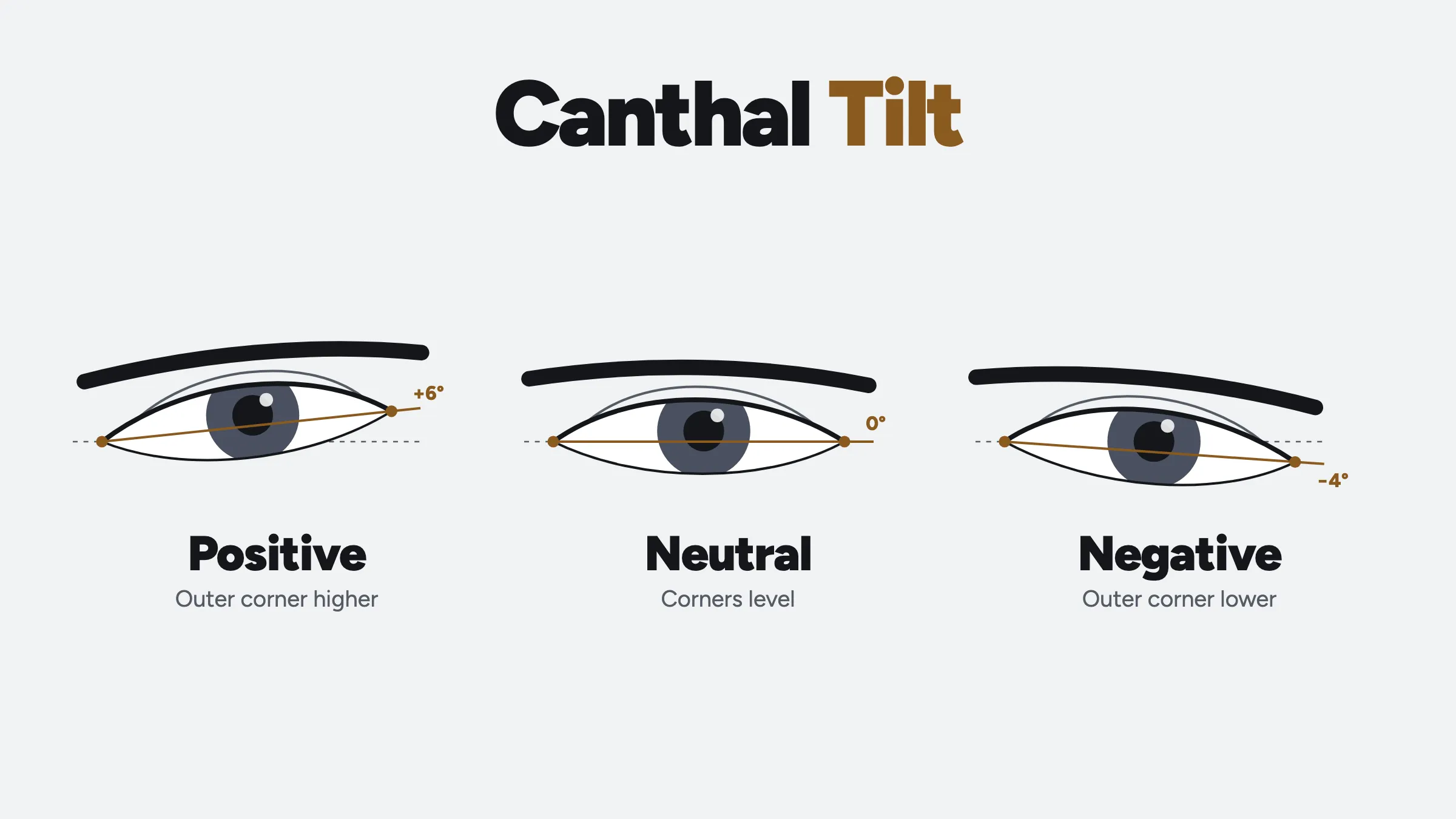
Positive is the usual arrangement. The average eye slants slightly upward at every age, and clinical genetics only calls an eye downslanting when the angle is more than two standard deviations below the average for that age.[4] A reading a little under zero is a direction, not a diagnosis.
How to measure your canthal tilt
The canthal tilt calculator reads both eyes from a front-on photo, in degrees, and runs on your own device. Whatever you measure with, two things about the photo move the number more than you’d expect.
Chin up or chin down
Researchers photographed 12 women at eye level with the head tipped from 15° down to 15° up, and measured how far the outer corner of each eye sat above the inner one.[3] With the head level, it was 2.55 mm. Chin down 15°, it rose to 4.39 mm. Chin up 15°, it fell to 0.13 mm, close to level.
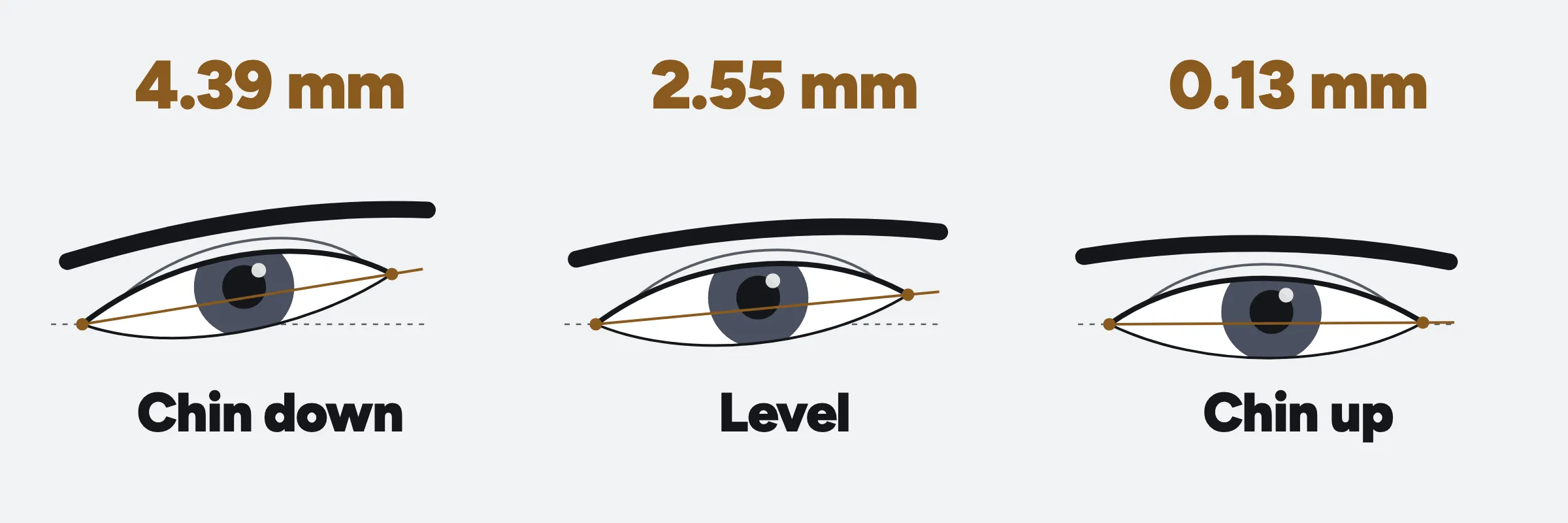
Same eyes, same sitting. The chin-down photos were also rated better looking. A camera held above your eye line does something similar, because what counts is the angle between your face and the lens.
Head tilted to one side
A sideways tilt works differently, and the arithmetic is simple. A tool that measures each eye against the photo’s horizontal, as ours does, adds the head’s tilt to one eye and takes it off the other. Tilt your head 3°, and two eyes that are really +4° each read +7° and +1°.
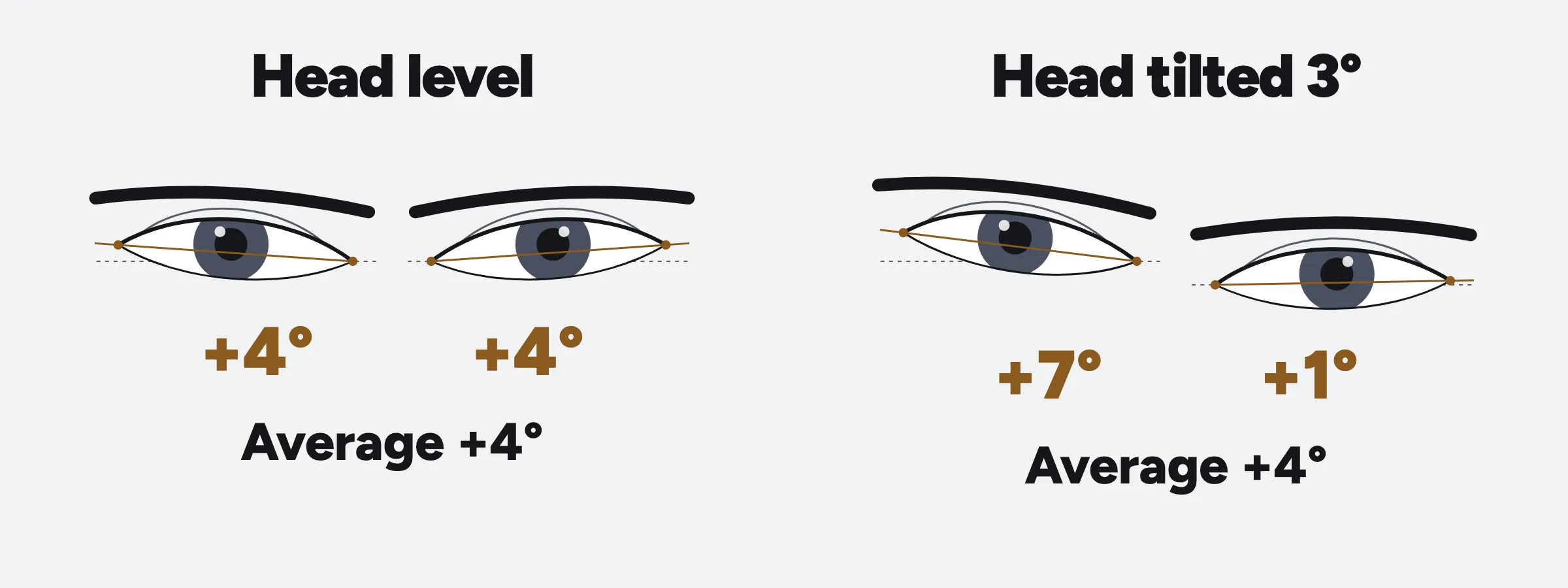
The average doesn’t move: 7 plus 1, halved, is still 4. The gap between your eyes does, by twice the head tilt. So take the average as your tilt, and treat a big left-right gap as a reason to retake the photo before you treat it as real asymmetry, which the face symmetry test measures across the whole face. The calculator flags a head tilted more than 4° for exactly this reason.
How to take a photo you can trust
- Camera at eye level. Not above, not below.
- Head level. Keep your ears in the frame. If they ride up or down against your eyes, your head is tipped.
- Neutral face, eyes on the lens. A smile pushes the lower lids up and changes where the corners read.
- Read the average of both eyes. If the two come back far apart, retake before believing either.
What’s a normal canthal tilt?
There isn’t one number. Every group of adults in the studies below averages a positive tilt, and the averages differ by population.
| Who was measured | Average tilt | Study |
|---|---|---|
| Caucasian men, 18 to 30 | +0.8° | Gao 2025[5] |
| Caucasian women, 18 to 30 | +2.4° | Gao 2025 |
| Chinese men, 18 to 30 | +4.9° | Gao 2025 |
| Chinese women, 18 to 30 | +6.0° | Gao 2025 |
| White adults, 18 to 39 | +2.5° | Fry 2017[6] |
| Latino adults, 18 to 39 | +6.0° | Fry 2017 |
| East Asian adults, 18 to 39 | +8.0° | Fry 2017 |
| Surgical patients, mean age 23 | +9.5° | Lee 2020[7] |
The studies don’t draw the reference line the same way. Gao measured against the line through both inner corners, and Fry against a standard head position, so compare within a study rather than across them. A common clinical rule of thumb puts the outer corner about 2 mm above the inner one,[6] and in the head-level photos above it was 2.55 mm.
Surgeons also use a simple classification: class I is 0° to 5°, class II is above 5°, and class III is below 0°.[7] It describes the angle for surgical planning. It doesn’t grade the face.
That’s why a single “ideal” number from an app or a video doesn’t mean much. The averages alone run from under 1° to over 9° depending on who was measured. If you compare your reading to anything, compare it to people with a background like yours, and read it as a description.
Does canthal tilt change with age?
Less than you’d think. In 320 people aged 10 to 89, aging didn’t move the outer corner at all, though it raised the skin crease and the brows and let the lower lid sag.[8] A study that photographed the same 80 people at 20, 40 and 60 found the outer corner looked lower in 40% of them by 60, and stable at 40.[9] When it drops, it drops late, and not for everyone.
Is a positive canthal tilt more attractive?
In looksmaxxing, a positive tilt is treated as the better one, and in real faces the research mostly agrees. Where it stops agreeing is extra lift added to a face. The evidence comes in two kinds.
Real faces. Three studies compared measured faces:
- Rated photos: 318 photos of young Black women were rated by 10 evaluators. The most attractive group averaged 9.1° and the least attractive 6.6°.[1]
- Contest entrants: 126 Italian beauty-contest entrants, men and women, had more upward eye inclination than 199 young adults who hadn’t entered.[10]
- Pageant contestants: in Korea, 43 contestants and 48 other young women showed no difference in slant.[11]
Edited faces. Two experiments changed the outer corner and asked people to rate the result:
- 2,081 raters, one face: raising the outer corner past its natural position lowered ratings for attractiveness, masculinity and trustworthiness, and raised ratings for dominance and threat.[2]
- 50 raters, exaggerated edits: lifting the outer corner “sharply reduces the attractiveness in male and female faces”.[12]
How far to trust it. All five are single studies, none stronger than grade B under our evidence standards, and two of them compare contest entrants rather than ratings. Put together: a more upward tilt went with attractiveness in two of the three real-face studies, and lifting the corner past where it naturally sits rated lower in both experiments. None of the studies included faces with a natural negative tilt, so there’s no direct evidence on negative tilt either way. Even the least attractive group in the rated study averaged +6.6°.
Can you change your canthal tilt?
The outer corner is tied to bone. The lateral canthal tendon attaches to a small bump inside the eye socket, on the cheekbone, called Whitnall’s tubercle.[13] That’s why the options sort into three groups.
- Changes the angle: surgery on the outer corner, and nothing else. It’s covered in the next section.
- Changes how the eye reads: the brow, the lids and the photo. Botulinum toxin lifted the outer brow by 0.4 to 4.8 mm across 11 studies.[14] It moves the brow, not the corner, but the brow frames how the eye reads. Sleep loss made eyelids hang lower and eyes look more swollen.[15] Eyeliner drawn upward past the outer corner extends the line the eye reads along. And head position, as above, changes the reading itself.
- Changes nothing: eye exercises, taping and mewing. A PubMed search on October 6, 2026 found no study testing exercises or taping on the tilt, and no trial has tested mewing.
If what bothers you is how your eyes look rather than a number, the brow and sleep are where the measured changes are.
What canthal tilt surgery involves
Canthal tilt surgery means changing where the outer corner is anchored. It’s for adults, and it’s a decision for an oculoplastic surgeon, an eye doctor with extra training in plastic and reconstructive surgery.[16]
- Lateral canthoplasty: the tendon is cut free and reanchored to the bony rim of the eye socket.[17] In the West it’s mostly done to lift a slant caused by aging. In East Asia, cosmetic canthoplasty is often done to lower the slant instead.
- Lateral canthopexy: the tendon is tightened with stitches without being detached.[18]
- Thread lifts: threads placed under the skin to pull tissue upward, including at the outer brow. We found no study of complications from eye-area thread lifts specifically. Across 26 studies of facial thread lifts, 35% of patients had swelling, 10% skin dimpling and 6% abnormal skin sensation, and satisfaction fell from 98% just after to 88% in the long term.[19]
Reported complications of cosmetic canthoplasty include a misshapen outer corner, the change not holding, exposed lining of the eyelid, and a lower lid that turns outward.[17] The rating studies are also a reason to be careful about how far to go: in both experiments, more lift rated lower.[12]
A downward slant that’s new, or only on one side, is a reason to see an eye doctor either way.
Frequently asked questions
What canthal tilt is most attractive?
There’s no proven ideal. In the one study that rated real faces, the most attractive group averaged 9.1° and the least attractive 6.6°, both positive.[1] In edited faces, raising the outer corner past its natural position lowered attractiveness ratings.[2]
What canthal tilt is hunter eyes?
Hunter eyes is community shorthand for deep-set eyes with a positive tilt and little visible upper eyelid. There’s no set number of degrees. The tilt is one of four features in the look, and our guide to hunter eyes covers the other three.
How do I find my canthal tilt?
Take a front-on photo with the camera at eye level and your head level, then measure the angle from the inner to the outer corner of each eye. The canthal tilt calculator does both eyes and gives you the average, which a sideways head tilt doesn’t change.
Can you change a negative canthal tilt?
Only with surgery. The outer corner is anchored to bone by a tendon,[13] so exercises, taping and mewing don’t reach it. What changes how it reads without surgery is the brow, the lids and the photo.
Is negative or positive canthal tilt better?
Neither is better for your health. For looks, positive has the evidence behind it: in two of three studies of real faces, the more attractive group had the more upward tilt.[1] No study has tested natural negative tilts directly.
Do women have a more positive canthal tilt?
Slightly, in some groups. Among young Caucasian adults, women’s tilt averaged about 1.6° more than men’s. Among young Chinese adults the difference wasn’t significant.[5]
References
- [1] Patel, A. A., Garg, S. P., Wan, R., et al.. Periorbital Measurements of Attractiveness in Young Black Women: An Anthropometric Approach — Journal of Craniofacial Surgery , 2026 . ↩
- [2] Kempa, J., Kasielska-Trojan, A., Gabryszewski, M., et al.. Understanding the impact of eyebrow and lateral canthal height on the perception of character traits: A rating-based analysis of 2081 participants — Journal of Plastic, Reconstructive & Aesthetic Surgery , 2025 . ↩
- [3] Vaca, E. E., Bricker, J. T., Mioton, L. M., Fagien, S., & Alghoul, M. S.. The Influence of Sagittal Head Tilt on Periorbital Appearance: Implications for Clinical Photography and the Evaluation of Postoperative Results — Aesthetic Surgery Journal Open Forum , 2022 . ↩
- [4] Hall, B. D., Graham, J. M., Cassidy, S. B., & Opitz, J. M.. Elements of morphology: standard terminology for the periorbital region — American Journal of Medical Genetics Part A , 2009 . ↩
- [5] Gao, T., Guo, Y., Rokohl, A. C., et al.. Racial and sexual differences of eyebrow and eyelid morphology: 3D analysis in young Caucasian and Chinese populations — Quantitative Imaging in Medicine and Surgery , 2025 . ↩
- [6] Fry, C. L., Naugle, T. C., Cole, S. A., et al.. The Latino Eyelid: Anthropometric Analysis of a Spectrum of Findings — Ophthalmic Plastic & Reconstructive Surgery , 2017 . ↩
- [7] Lee, J., Choung, H., & Choung, P.. Diagnostic analysis of vertical orbital dystopia and canthal tilt for surgical correction — Journal of the Korean Association of Oral and Maxillofacial Surgeons , 2020 . ↩
- [8] van den Bosch, W. A., Leenders, I., & Mulder, P.. Topographic anatomy of the eyelids, and the effects of sex and age — British Journal of Ophthalmology , 1999 . ↩
- [9] De Biasio, F., Miotti, G., Zingaretti, N., Castriotta, L., & Parodi, P. C.. Study on the Aging Dynamics of the Periorbital Region: From Observation to Knowledge of Physiopathology — Ophthalmic Plastic & Reconstructive Surgery , 2019 . ↩
- [10] Sforza, C., Dolci, C., Grandi, G., Tartaglia, G. M., Laino, A., & Ferrario, V. F.. Comparison of soft-tissue orbital morphometry in attractive and normal Italian subjects — The Angle Orthodontist , 2015 . ↩
- [11] Kim, Y. C., Kwon, J. G., Kim, S. C., et al.. Comparison of Periorbital Anthropometry Between Beauty Pageant Contestants and Ordinary Young Women with Korean Ethnicity: A Three-Dimensional Photogrammetric Analysis — Aesthetic Plastic Surgery , 2018 . ↩
- [12] Kempa, J., Kasielska-Trojan, A., Antoszewski, B., et al.. Measuring the effects of facial regional changes following excessive aesthetic treatments: A survey and eye-tracking-based investigation — Journal of Plastic, Reconstructive & Aesthetic Surgery , 2025 . ↩
- [13] Bergeron, J. M., Hohman, M. H., & Raggio, B. S.. Zygomatic Arch Fracture — StatPearls, NCBI Bookshelf , 2024 . ↩
- [14] Jabbour, S., Awaida, C., Kechichian, E., et al.. Botulinum Toxin for Eyebrow Shaping: A Systematic Review — Dermatologic Surgery , 2017 . ↩
- [15] Sundelin, T., Lekander, M., Kecklund, G., et al.. Cues of fatigue: effects of sleep deprivation on facial appearance — Sleep , 2013 . ↩
- [16] Oculoplastic procedures — MedlinePlus, US National Library of Medicine , 2024 . ↩
- [17] Kim, Y. J., Lee, K. H., Choi, H. L., & Jeong, E. C.. Cosmetic Lateral Canthoplasty: Preserving the Lateral Canthal Angle — Archives of Plastic Surgery , 2016 . ↩
- [18] Qureshi, Z., Bernard, A., Grisolia, A. B. D., et al.. Simplified technique for lateral canthal tendon canthopexy — Indian Journal of Ophthalmology , 2022 . ↩
- [19] Niu, Z., Zhang, K., Yao, W., et al.. A Meta-Analysis and Systematic Review of the Incidences of Complications Following Facial Thread-Lifting — Aesthetic Plastic Surgery , 2021 . ↩
Related articles
Hunter Eyes: What They Are & Can You Get Them?
What hunter eyes are, how they differ from prey eyes, and whether you can get them. The research backs an upward tilt and a low brow, but not extra lift.

Orka Interview: Going Above & Beyond to Looksmax
From social isolation to one of the most referenced users in the scene - Orka shares his unfiltered looksmaxxing journey.

Survey Reveals: 45.5% of Teens Under 18 Are Considering Surgery in the Future to Enhance Their Looks
Survey reveals youth-driven looksmaxxing trends, showing both positive life impacts and rising mental health concerns around appearance.