Gonial Angle: What's Normal and How It's Measured
What a normal gonial angle is, what's considered attractive, and why the number from a selfie or face app isn't the one doctors measure.

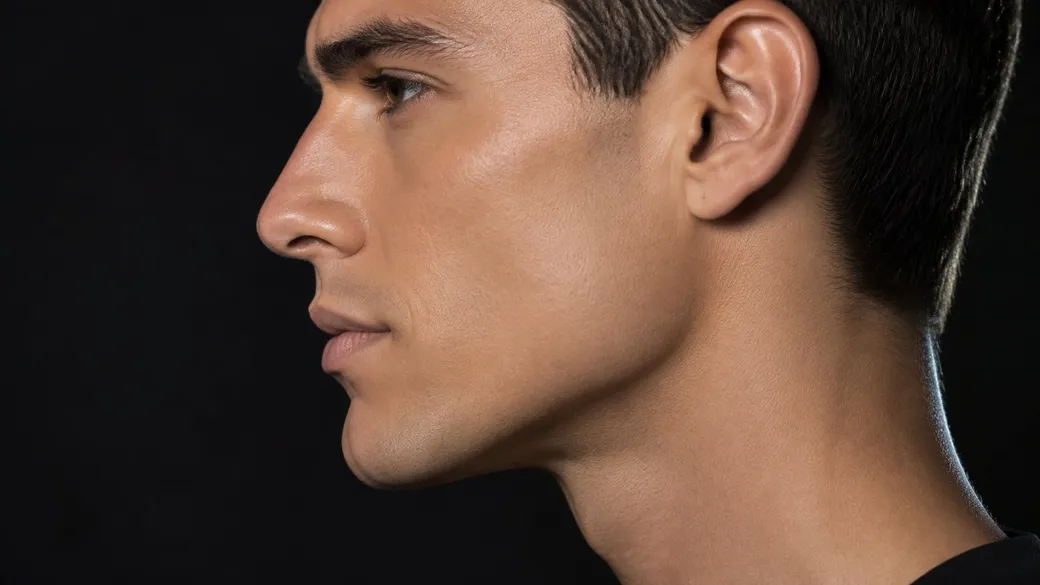
The gonial angle is the angle at the back corner of the jaw, where the vertical branch (the ramus) meets the horizontal body of the mandible. It's measured from the side, usually on an X-ray. On side X-rays, adult averages run from about 117° to 128°. A smaller angle makes a squarer jaw corner.
In looksmaxxing, a gonial angle around 120° or sharper is treated as the ideal. On side X-rays, adults average about 117° to 128°, with men and women a few degrees apart.[1][2]
If your number came from a selfie or an app, though, it isn’t measured the way doctors measure it, and nobody has checked whether it matches.
What the gonial angle is
The lower jaw, the mandible, has a vertical branch that runs up toward the ear, the ramus, and a horizontal body that runs forward to the chin. The gonial angle is the angle between them, measured at the jaw corner, a point called the gonion. Clinically it’s taken from two lines: one along the back edge of the ramus, one along the lower border of the jaw.
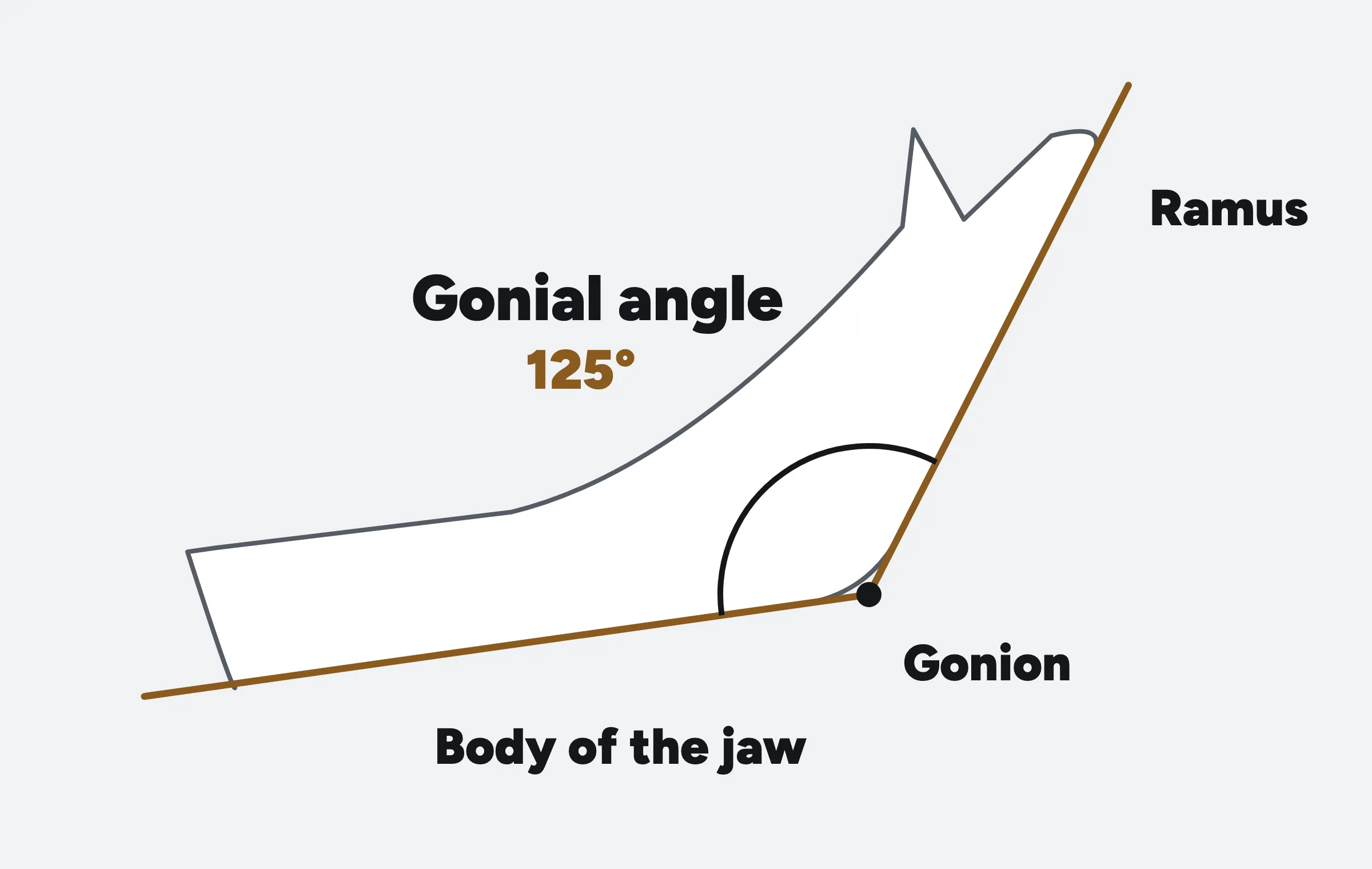
A smaller angle makes a squarer, more defined jaw corner. A larger one makes the lower jaw slope more steeply, and in growing children it goes with a longer lower face.[3]
How it’s measured, and what a photo can tell you
The reference method is a side X-ray of the skull, a lateral cephalogram. Everything else is compared against it, and none of the alternatives matches it exactly.
| Method | What it measures | How it compares with a side X-ray |
|---|---|---|
| Panoramic X-ray | The bone, both sides at once | 3° higher in one study,[1] 7° lower in another[4] |
| Side-profile photo | The skin outline over the jaw | Right on average, but explained only 42% of the variation between people[5] |
| Front-on photo or app | The jaw corner seen from the front, a different angle | Never checked against an X-ray |
The profile-photo study is the useful one. Across 120 people, the photo and the X-ray averaged within a degree of each other. But for any one person the two only loosely agreed, because the skin, fat and muscle over the bone change the outline the camera sees.[5]
The front-on photo is the easiest to take, and it’s the weakest. From the front you’re looking at the jaw corner from a different direction, so the same jaw gives a different number. We searched PubMed on October 7, 2026 for any study comparing a front-view jaw angle with the X-ray angle and found none.
Our gonial angle calculator reads the jaw corner from a front-on photo, and says so. Use it to compare your own photos taken the same way and to check your two sides, not to compare yourself with the X-ray figures below.
What’s a normal gonial angle?
On side X-rays, adult averages run from about 117° to 128°, depending on who was measured. In one study of 448 adults aged 18 to 30, men averaged 126° and women 128°.[1] In another, of 266 people in Spain, the angle was about 3° larger in men than women after age 16.[2]
So the difference between men and women is a few degrees, and samples disagree on which way it runs. A normal range for one sex is a normal range for the other.
You’ll often see “124° for men and 122° for women” quoted as the standard, credited to a 1974 growth atlas. We couldn’t trace those exact figures to it. The one verified statement of the atlas’s numbers puts the average boy at 132° at age 6, narrowing to 124° by 16.[6]
Does the gonial angle change with age?
Yes, in both directions over a lifetime. It narrows through childhood and the teens, and the narrowing slows or stops from about 21.[2] In older adults it widens again, even with their teeth,[7] and jaws that have lost all their teeth average about 4° wider.[8]
What gonial angle is most attractive?
In looksmaxxing, a side-view angle around 120° or sharper is treated as the ideal, especially for men. No study has tested it: we searched PubMed on October 7, 2026 for any study that changed the gonial angle and asked people to rate the result, and found none.
What the research does support is that more masculine-looking features rate as more attractive in men’s faces.[9] But the gonial angle itself barely differs between men and women, so a sharp angle isn’t, on its own, a masculine one.
What makes a jaw read as sharp, from any direction, is mostly what sits on the bone. Body fat over the jawline comes first: it’s the one change that shows in weeks rather than years, and the body fat calculator gives you something to track.
Can you change your gonial angle?
The angle is the shape of a bone, so the options sort into three groups.
- Changes the bone: surgery, and nothing else. Jaw-angle reduction, implants and corrective jaw surgery all exist, and they’re decisions for a qualified maxillofacial surgeon, as an adult. At one large hospital, complications after jaw-angle reduction fell from 13% to 2.5% of operations over 15 years as technique changed.[10]
- Changes how the jaw reads: body fat, first. Botulinum toxin in the masseter, the chewing muscle over the jaw corner, narrowed the lower face by about 5 mm in a large trial.[11] A jawline filler improved jaw definition in 69% of treated people at six months, against 38% of controls.[12] Neither changes the bone angle.
- Changes nothing: chewing gum and jaw exercisers. In a randomised trial, six months of gum three times a day made bite force stronger but changed neither jaw shape nor masseter thickness.[13] No trial has tested mewing on the jaw.
Bonesmashing is a dangerous online trend of deliberately striking the face to try to alter bone. Nothing supports it, and it can fracture the jaw or damage the nerves that run through it. If you’re thinking about it, the options above are what actually change how a jaw looks.
Frequently asked questions
Is a 120 gonial angle good?
It’s at the sharper end of normal. On side X-rays, adult averages run from about 117° to 128°,[1] so 120° is well within the usual range, and it’s the figure looksmaxxing treats as the ideal. Check how it was measured first: a number from a front-on photo isn’t comparable.
What causes a high gonial angle?
Mostly the way the jaw grew. A larger angle goes with a jaw that slopes more steeply and a longer lower face.[3] It also widens with age and with tooth loss.[8]
How do I measure my gonial angle?
Properly, from a side X-ray, which an orthodontist can take and read. A side-profile photo gets close on average but not reliably for one person.[5] A front-on photo measures a different angle, though it’s fine for comparing your own photos over time.
What is the ideal gonial angle for a man?
In looksmaxxing, about 120° or sharper. No study has tested whether a particular angle rates better, and men’s and women’s angles differ by only a few degrees. Body fat over the jaw does more for how sharp it looks.
Can fillers change your gonial angle?
Not the bone. A jawline filler can make the jaw edge look more defined,[12] but the angle on an X-ray stays the same. It’s a procedure for a qualified injector, as an adult.
References
- [1] Tashkandi, N. E., Alnaqa, N. H., Al-Saif, N. M., & Allam, E.. Accuracy of Gonial Angle Measurements Using Panoramic Imaging versus Lateral Cephalograms in Adults with Different Mandibular Divergence Patterns — Journal of Multidisciplinary Healthcare , 2024 . ↩
- [2] Larrazabal-Moron, C., & Sanchis-Gimeno, J. A.. Gonial angle growth patterns according to age and gender — Annals of Anatomy , 2018 . ↩
- [3] Chung, C. H., Mongiovi, V. D., et al.. Craniofacial growth in untreated skeletal Class I subjects with low, average, and high MP-SN angles: a longitudinal study — American Journal of Orthodontics and Dentofacial Orthopedics , 2003 . ↩
- [4] Araki, M., Kiyosaki, T., Sato, M., Kohinata, K., et al.. Comparative analysis of the gonial angle on lateral cephalometric radiographs and panoramic radiographs — Journal of Oral Science , 2015 . ↩
- [5] Gupta, S., Tandon, P., Singh, G. P., Shastri, D., et al.. Comparative assessment of cephalometric with its analogous photographic variables — National Journal of Maxillofacial Surgery , 2022 . ↩
- [6] Aristide, A. S., Dragomirescu, A. O., Bencze, M. A., et al.. Vertical Cephalometric Characteristics in Class III Malocclusions — Current Health Sciences Journal , 2022 . ↩
- [7] Shaw, R. B. Jr., Katzel, E. B., Koltz, P. F., Kahn, D. M., et al.. Aging of the mandible and its aesthetic implications — Plastic and Reconstructive Surgery , 2010 . ↩
- [8] Hutchinson, E. F., Farella, M., & Kramer, B.. Importance of teeth in maintaining the morphology of the adult mandible in humans — European Journal of Oral Sciences , 2015 . ↩
- [9] Rhodes, G.. The Evolutionary Psychology of Facial Beauty — Annual Review of Psychology , 2006 . ↩
- [10] Xie, Z., Yan, S., Qiao, C., et al.. Mandibular Angle Osteotomy via Intraoral Approach: A 15-Year Experience from a Single Plastic Surgery Center in China — Aesthetic Plastic Surgery , 2025 . ↩
- [11] Sun, J., Wang, L., Wu, Y., et al.. OnabotulinumtoxinA Treatment for Masseter Muscle Prominence: 6-Month Safety and Efficacy Results, Including Patient-Reported Outcomes, From a Phase 3, Randomized, Placebo-Controlled, Multiregional Trial — Aesthetic Surgery Journal , 2026 . ↩
- [12] Rivkin, A., Green, J. B., Bruce, S., et al.. Safe and Effective Restoration of Jawline Definition With Hyaluronic Acid Injectable Gel VYC-25L: Results From a Randomized Controlled Study — Aesthetic Surgery Journal , 2024 . ↩
- [13] Jung, H. J., Hwangbo, N. K., Park, Y., & Ahn, H. J.. Effects of gum chewing training on occlusal force, masseter muscle thickness and mandibular shape: A randomised controlled clinical trial — Journal of Oral Rehabilitation , 2024 . ↩
Related articles
Canthal Tilt: What's Normal and What's Attractive
What canthal tilt is, what's normal, and whether positive really beats negative. In rated photos, the most attractive faces had the most upward tilt.
Hunter Eyes: What They Are & Can You Get Them?
What hunter eyes are, how they differ from prey eyes, and whether you can get them. The research backs an upward tilt and a low brow, but not extra lift.
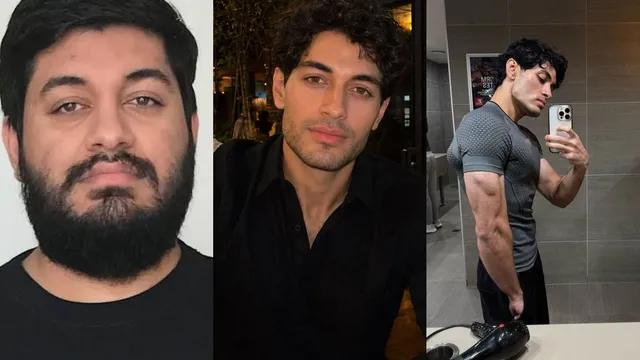
Sal P: A Complete Looksmaxxing Transformation at 28
Obese and burnt out at 28, barely recognizable four years later. Every stage in the order he did it, for anyone who thinks they started too late.