Flat Maxilla: How to Tell and What Changes It
What a flat maxilla is, how it differs from a recessed one, how to tell from your profile, and what actually changes it at every age.


A flat maxilla is a flatter-looking midface, the area beside the nose and under the cheekbones. It isn't a diagnosis. It overlaps with a recessed maxilla, where the whole upper jaw sits further back, but a face can look flat with a normal bite. A side X-ray, or a measured angle on a profile photo, tells them apart.
A flat maxilla is usually easy to spot from the side: the area beside the nose looks flat, and the midface runs straight down or dips in instead of curving forward. For a borderline profile, a measured angle on a side-profile photo settles it.[1]
And flat and recessed aren’t the same thing. A face can look flat through the midface with a perfectly normal bite.[2]
Flat vs recessed maxilla
The maxilla is the upper jaw. It holds the top teeth and forms the floor of the nose and much of the cheek area, the middle of the face that our facial thirds test measures from the front. “Flat maxilla” and “recessed maxilla” are community terms, and they get used for two different things:
- Recessed means the whole upper jaw sits further back than usual. It’s part of the Class III bite pattern, where the lower teeth sit in front of the upper ones, which about 6% of people worldwide have.[3]
- Flat describes how the midface looks: little projection beside the nose and under the cheekbones. Surgeons treat this kind of mild midface concavity even in people whose bite is normal.[2]
The two often travel together. In one CT study of people with a deficient midface and a Class III bite, the men had a flatter face and the women a concave lower cheekbone.[4] But a flat-looking midface on its own doesn’t mean the jaw is set back.
A forward lower jaw can make a normal maxilla look recessed, too, so a strong chin is worth ruling out before blaming the upper jaw.
How to tell from your side profile
A clear case shows in profile. Look for:
- Flatness beside the nose, where the cheek should curve forward around the nostril.
- A straight or dished midface, running down from the eyes instead of forward.
- An upper lip that sits back, level with or behind the lower lip.
- Lower front teeth in front of the upper ones when you bite, the sign of a set-back upper jaw rather than just a flat-looking one.
Borderline profiles are harder to call. When eight orthodontists sorted 37 featureless profile silhouettes into skeletal types, they matched the X-ray only 29% of the time.[5] That’s the case for measuring when you’re not sure.
A measured angle settles it. The soft-tissue angle runs from the point between your eyes to two points: the deepest point above your upper lip, and the deepest point below your lower lip. Under 6 degrees, it caught a Class III pattern with 90.5% sensitivity and 81% specificity.[1]
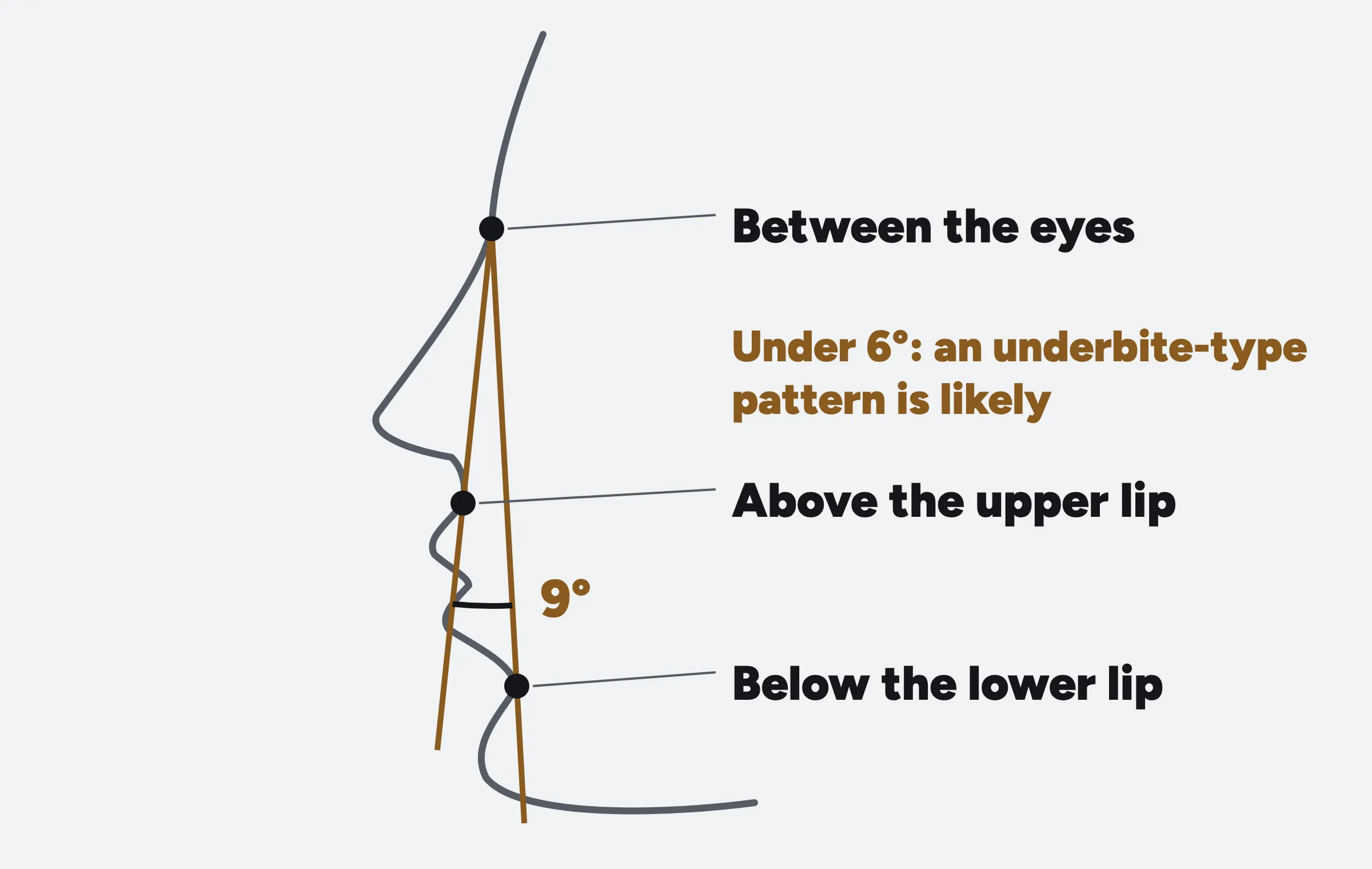
To measure it yourself:
- Take a strict side profile, camera at face height, head level, lips relaxed.
- Mark the three points and draw a line from the top point to each of the other two.
- Measure the angle between the lines. Under 6° points to a Class III pattern.
That study measured men, and the test detects a Class III pattern, which can come from a set-back maxilla, a forward lower jaw or both. To know which, you need a side X-ray, which an orthodontist can take and read. It’s the same X-ray used to measure the jaw’s gonial angle.
There’s no single number that means “recessed”. On X-rays, upper jaw position is measured as the SNA angle, and the common reference is 82°. But normal varies by population: one group of adults with pleasing profiles averaged 87.5°.[6] A cutoff quoted without saying which population it came from isn’t a cutoff.
Is a flat maxilla attractive?
The general consensus in the looksmaxxing community is that forward growth, a well-projected midface, is the ideal, and a flat maxilla something to fix. The research broadly agrees on which profile people prefer, if not on how much it matters:
- Straight profiles rate best. Ratings fell the further a profile moved from straight in either direction, with roughly 10° convex to 12° concave still judged acceptable.[7]
- The set-back upper jaw profile rated lowest. When raters ranked profiles, 48% put the one with a set-back maxilla and a forward lower jaw last.[8]
- Moving it changed perceptions. After jaw surgery for a deficient upper jaw, patients were rated more attractive, friendlier and more trustworthy from photographs, in a small study where they also had chin surgery.[9]
So a mild flatness sits inside the range people find attractive. A pronounced set-back maxilla with an underbite is the profile people rate lowest.
When does the maxilla stop growing?
There’s no fixed age. The seam down the middle of the palate, which is what expansion works on, is fused in most adults, but about one in eight still have it open, and age alone doesn’t predict who.[10]
What does matter is growth. Treatments that guide the maxilla forward work in children who are still growing, as the next section shows.
What changes a flat maxilla, by age
| Age | What works | How much |
|---|---|---|
| Children, about 5 to 13 | Facemask (reverse-pull headgear) | Bite improves short term; the gain fades by six years, but fewer later need surgery[11] |
| Teens and adults | Palate expansion with miniscrews (MARPE) | Widens the palate in about 92%,[12] but moves the jaw forward under 1°[13] |
| Adults | Jaw surgery (Le Fort I or both jaws) | Moves the bone itself; a decision for a maxillofacial surgeon |
| Any adult age | Implants or fillers beside the nose | About 4 mm of added projection in one case series; soft tissue only[2] |
In children, a Cochrane review of 29 trials found a facemask improved the bite in the short term. The benefit shrank by three years and appeared to be lost by six, but treated children were judged less likely to need jaw surgery as adults.[11] That’s a conversation for an orthodontist, ideally early.
In teens and adults, miniscrew palate expansion (MARPE) widens the palate in about 92% of cases,[12] and it’s sometimes sold as a way to bring the maxilla forward. It moves it forward by less than a degree on average.[13]
Jaw surgery is what actually moves the maxilla. It’s an adult decision for a qualified maxillofacial surgeon, with real recovery and risks. When it’s done for sleep apnea, moving both jaws forward succeeded in 86% of patients and cured it in 43%.[14]
Implants beside the nose added about 4 mm of projection in a series of 93 people with a flat midface and a normal bite. A few needed removal or had the implant shift, and some had temporary numbness.[2] It’s a case series, not a trial, so treat it as what’s possible rather than what to expect.
What doesn’t change it: no trial has tested mewing, chewing or face pulling on the maxilla. We searched PubMed on October 8, 2026 for trials of mewing and found none. If you want the community’s case for tongue posture, our interview with Dr Mike Mew covers what its main proponent argues, and AstroSky’s mewing story is one member’s account.
What causes a flat maxilla?
Mostly the way the face and jaws grew. Mouth breathers average a slightly more set-back upper jaw than nose breathers, about 1.3 degrees, but that’s an association, not proof that mouth breathing causes it.[15] No human trial links diet, chewing or tongue posture to how far forward the maxilla grows.
Frequently asked questions
Is a flat maxilla the same as a recessed one?
Not quite. Recessed means the whole upper jaw sits further back; flat describes a midface with little projection, which can happen with a normal bite.[2] They often appear together, and a bite check or a side X-ray separates them.
Does a flat maxilla cause sleep apnea?
There’s no good evidence that it does. In adults with sleep apnea, the measured differences were a shorter upper jaw and a set-back lower jaw, not the forward position of the maxilla.[16] Jaw-advancement surgery does treat sleep apnea well,[14] which is a different thing from a flat maxilla causing it.
How do I fix a flat maxilla naturally?
The bone doesn’t move without treatment, and no trial supports mewing, chewing or face pulling. In children, a facemask can help.[11] In adults, the non-surgical options change how the midface looks, not the jaw: implants or fillers beside the nose, which are procedures for an adult with a qualified practitioner.
Do I need to fix a flat maxilla?
Only if it bothers you or causes a problem. A mild flatness sits inside the range of profiles people rate as attractive.[7] If you want to see how your proportions compare from the front, the facial ratios calculator measures midface length. A bite problem, trouble breathing through your nose or loud snoring are reasons to see an orthodontist or doctor regardless.
References
- [1] Staudt, C. B., & Kiliaridis, S.. A nonradiographic approach to detect Class III skeletal discrepancies — American Journal of Orthodontics and Dentofacial Orthopedics , 2009 . ↩
- [2] Kim, J. H., Jung, M. S., Lee, B. H., et al.. Silicone Implant-Based Paranasal Augmentation for Mild Midface Concavity — Archives of Craniofacial Surgery , 2016 . ↩
- [3] Alhammadi, M. S., Halboub, E., Fayed, M. S., et al.. Global distribution of malocclusion traits: A systematic review — Dental Press Journal of Orthodontics , 2018 . ↩
- [4] Kim, B., Lee, H. C., Kim, S. H., et al.. Hard- and soft-tissue profiles of the midface region in patients with skeletal Class III malocclusion using cone-beam computed tomography multiplanar-reconstructed image analysis — Korean Journal of Orthodontics , 2018 . ↩
- [5] Schwabe, S. A., & Caldwell, S.. Can anteroposterior skeletal pattern be determined from a silhouetted profile photograph? A cross-sectional study — Journal of Orthodontics , 2022 . ↩
- [6] Hamad, A. K., Machibya, F. M., Mlangwa, M. M., et al.. Cephalometric Characteristics of Various Ethnic Groups in Tanzania — International Journal of Dentistry , 2025 . ↩
- [7] Naini, F. B., Donaldson, A. N., McDonald, F., et al.. Assessing the influence of lower facial profile convexity on perceived attractiveness in the orthognathic patient, clinician, and layperson — Oral Surgery, Oral Medicine, Oral Pathology and Oral Radiology , 2012 . ↩
- [8] Hamad, A. K., Machibya, F. M., Mlangwa, M. M., et al.. Tanzanian Population's Perspective on Facial Profile Esthetic Preferences — International Journal of Dentistry , 2025 . ↩
- [9] Posnick, J. C., & Kinard, B. E.. Orthognathic Surgery Has a Significant Positive Effect on Perceived Personality Traits and Perceived Emotional Facial Expressions in Subjects with Primary Maxillary Deficiency — Plastic and Reconstructive Surgery Global Open , 2019 . ↩
- [10] Angelieri, F., Franchi, L., Cevidanes, L. H. S., et al.. Cone beam computed tomography evaluation of midpalatal suture maturation in adults — International Journal of Oral and Maxillofacial Surgery , 2017 . ↩
- [11] Owens, D., Watkinson, S., Harrison, J. E., et al.. Orthodontic treatment for prominent lower front teeth (Class III malocclusion) in children — Cochrane Database of Systematic Reviews , 2024 . ↩
- [12] Kapetanović, A., Theodorou, C. I., Bergé, S. J., et al.. Efficacy of Miniscrew-Assisted Rapid Palatal Expansion (MARPE) in late adolescents and adults: a systematic review and meta-analysis — European Journal of Orthodontics , 2021 . ↩
- [13] Xie, B., Zhang, L., & Lu, Y.. Skeletal Effects After Miniscrew-Assisted Rapid Palatal Expansion on Sagittal and Vertical Dimensions: A Systematic Review and Meta-Analysis — International Dental Journal , 2026 . ↩
- [14] Holty, J. E., & Guilleminault, C.. Maxillomandibular advancement for the treatment of obstructive sleep apnea: a systematic review and meta-analysis — Sleep Medicine Reviews , 2010 . ↩
- [15] Zheng, W., Zhang, X., Dong, J., et al.. Facial morphological characteristics of mouth breathers vs. nasal breathers: A systematic review and meta-analysis of lateral cephalometric data — Experimental and Therapeutic Medicine , 2020 . ↩
- [16] Neelapu, B. C., Kharbanda, O. P., Sardana, H. K., et al.. Craniofacial and upper airway morphology in adult obstructive sleep apnea patients: A systematic review and meta-analysis of cephalometric studies — Sleep Medicine Reviews , 2017 . ↩
Related articles
Gonial Angle: What's Normal and How It's Measured
What a normal gonial angle is, what's considered attractive, and why the number from a selfie or face app isn't the one doctors measure.
Canthal Tilt: What's Normal and What's Attractive
What canthal tilt is, what's normal, and whether positive really beats negative. In rated photos, the most attractive faces had the most upward tilt.

Hunter Eyes: What They Are & Can You Get Them?
What hunter eyes are, how they differ from prey eyes, and whether you can get them. The research backs an upward tilt and a low brow, but not extra lift.