Your face shape, matched against six common ones from the real outline of your face rather than by eye. You get the closest match, the runner-up, and the three ratios behind both.
Choose one clear, front-on photo
Looking at the camera, even light, hair off your forehead, no
glasses.
JPG, PNG or WebP up to 10 MB, or drag one here
Your photo never leaves your device.
Closest face shape
Add a photo and this fills in.
How clear the match is
not yet
Next closest
not yet
Face length to width
not yet
Jaw to cheekbone width
not yet
Forehead to cheekbone width
not yet
Typically oval, round, square, oblong, heart or diamond
Taking the measurement
1
Take a front-on photo
Hair off your forehead and ears, square to the camera, neutral expression. Hair covering the outline is the main cause of a wrong answer.
2
Choose the file
Measured in your browser. Nothing is uploaded.
3
Read both shapes
If the runner-up is close, treat your face as between the two. Most styling advice for either will work.
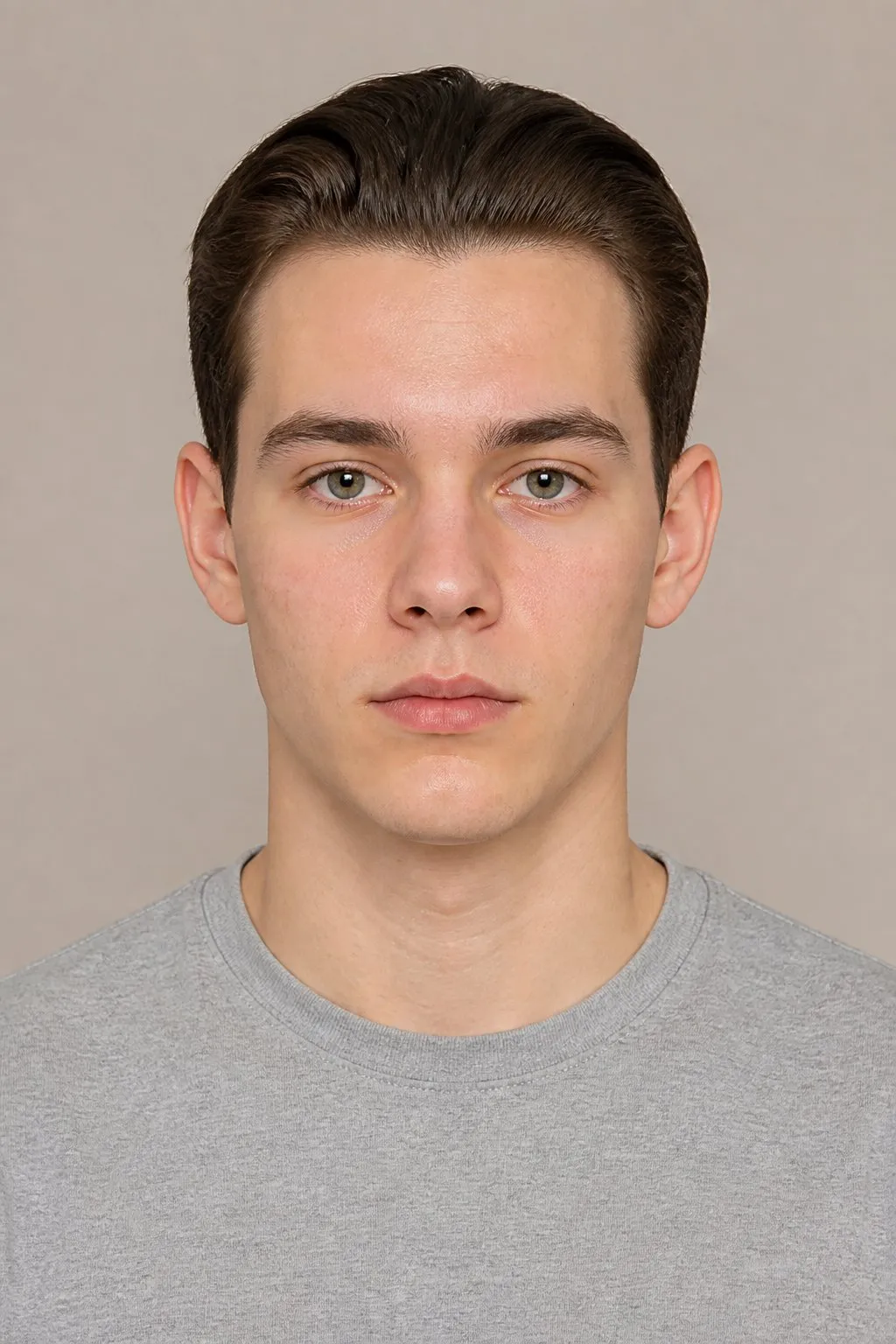
Example
Forehead, cheekbone and jaw widths, against face length.
Drawn from the landmarks our own measurement reads off this photo, not
placed by hand. It is a generated face, not a real person, and nothing
here is a verdict about it.
This measures three ratios from your face outline and matches them against six common shapes: oval, round, square, oblong, heart and diamond. It reports the closest match and the runner-up, because most faces sit between two shapes rather than squarely in one.
How this is worked out
Face length to width
Top of the face outline to the chin, divided by the width across the cheekbones. This separates the long shapes from the round ones and does most of the work.
Jaw to cheekbone width
How square the lower face is. A jaw close to cheekbone width reads square; a much narrower one reads heart or oval.
Forehead to cheekbone width
Separates heart from diamond, which share a narrow jaw and differ at the top.
The match
Each shape has a profile of expected ratios and your measurements are scored against all six. The runner-up is shown because a close second means your face genuinely sits between two, which is common.
What each measurement is
Reference bands are this tool's own, chosen for the landmarks it uses.
Where research reports a figure it is given separately, with the source,
because the two are different claims. And each one says what actually
moves it, which for most facial measurements is the more useful half.
Closest face shape
Formula
the three width and length ratios below, scored against six shape profiles
Reference
oval, round, square, oblong, heart or diamond
A styling taxonomy from hairdressing and eyewear, not a clinical classification. There is no agreed boundary between the shapes, which is why tools disagree.
What moves it There is no shape to aim for and no research establishing one - this is the measurement on the site where that is genuinely the whole answer, because the categories come from hairdressing rather than from a study. What the result is for is balance: add height to a round or square face, add width to a long one, soften a hard jaw. A barber who can see you beats any rule of thumb, and this gives you the word to use with them.
How clear the match is
Most faces sit between two shapes rather than squarely in one. Where the top two are close this says so, because naming one of them without the hedge would claim a precision the measurement does not have.
Next closest
A close second means your face genuinely sits between two, which is common.
Face length to width
Formula
face length ÷ cheekbone width
Reference
1.3 to 1.5 on this tool's anchors
Jaw to cheekbone width
Formula
jaw width ÷ cheekbone width
Reference
0.76 to 0.82 on this tool's anchors
Forehead to cheekbone width
Formula
forehead width ÷ cheekbone width
Reference
0.85 to 0.95 on this tool's anchors
This measures three ratios from your face outline and tells you which of six
shapes they sit closest to, plus the runner-up.
The runner-up is not padding. Most faces genuinely sit between two categories,
and a tool that hides that is pretending to a precision the taxonomy does not
have.
What is actually being measured
Face length to width does most of the work, separating the long shapes from
the short ones.
Jaw to cheekbone width measures how square the lower face is.
Forehead to cheekbone width separates heart from diamond, which share a
narrow jaw and differ at the top.
All three are printed with your result, so you can see what produced the label
rather than being handed a category to accept.
These categories are a styling taxonomy, not a science
Worth saying plainly, because every page on this query implies otherwise.
Oval, round, square, oblong, heart and diamond are a convention from hairdressing
and eyewear. There is no agreed definition of where one ends and another begins,
no published measurements setting the boundaries, and different sources use
different sets, some with seven or eight shapes.
That is why two face shape tools disagree about the same face. Not because one
is broken, but because there was never anything to agree on.
None of that makes the taxonomy useless. It is genuinely good at the job it
was invented for, which is deciding what suits you. It is just not a finding
about your face, and there is no research establishing an attractive shape.
What oval being a cheat code actually means
Oval is usually described as the shape everything suits.
The defensible version of that is narrow: an oval face has no strongly dominant
feature to balance against, so fewer haircuts and frames fight it. That is a
convenience for whoever is choosing your glasses, and it is not a rank.
What changes the answer
Hair is the main cause of a wrong result. Hair across the forehead or over
the ears hides the outline the measurement needs. Pull it back.
Body fat changes how the outline photographs, which is why the same person
measures round at one weight and oval at another. The bone has not moved. The
body fat estimate is the figure actually changing.
Camera angle, as everywhere in this section.
Where to go next
The jawline tool measures the lower face in more detail,
including the gonial angle, which is what a square reading actually rests on.
The facial ratios calculator gives you a dozen
proportions from the same photo, and the
symmetry test scores the outline’s two sides against each
other.
Frequently asked questions
What is my face shape?
This tool measures three ratios from your face outline and matches them against six shapes. It reports the closest and the next closest, because faces rarely sit cleanly in one category.
What are the six face shapes?
Oval, round, square, oblong, heart and diamond. They are a styling taxonomy rather than a scientific classification, and different sources use slightly different sets.
What is the most attractive face shape?
No study establishes one, and the reason is structural: these six categories come from hairdressing rather than from research, so there is nothing with an agreed definition to test. What the research does support is averageness and symmetry, neither of which maps onto a shape label. Face shape tells you what will suit you.
Why did I get a different answer from another tool?
Because these categories have no standard definition. Every tool picks its own boundaries between them. Ours prints the three ratios it used so you can see the reasoning rather than just the label.
Is oval the best face shape?
Oval is often called a styling cheat code, and the useful version of that claim is narrow: it has no strongly dominant feature, so fewer haircuts and frames need balancing against it. That is a convenience, not a rank.
How do I know if my face is square or round?
Both have a jaw close to cheekbone width. The difference is length: a round face is shorter relative to its width, a square one longer with a harder jaw line. The two ratios on this page separate them.
Can your face shape change?
The underlying bone does not change in an adult. Body fat changes how the outline reads in a photo, which is why some people measure as round at one weight and oval at another.
Does hair affect the result?
It affects the detection. Hair across the forehead or over the ears hides the outline the measurement needs. Pull it back before taking the photo.
What haircut suits my face shape?
The general principle is balance: add height to a round or square face, add width to a long one, soften a hard jaw. A barber who can see you will beat any rule of thumb.
Is my photo uploaded?
No. It is measured in your browser and nothing is sent anywhere.