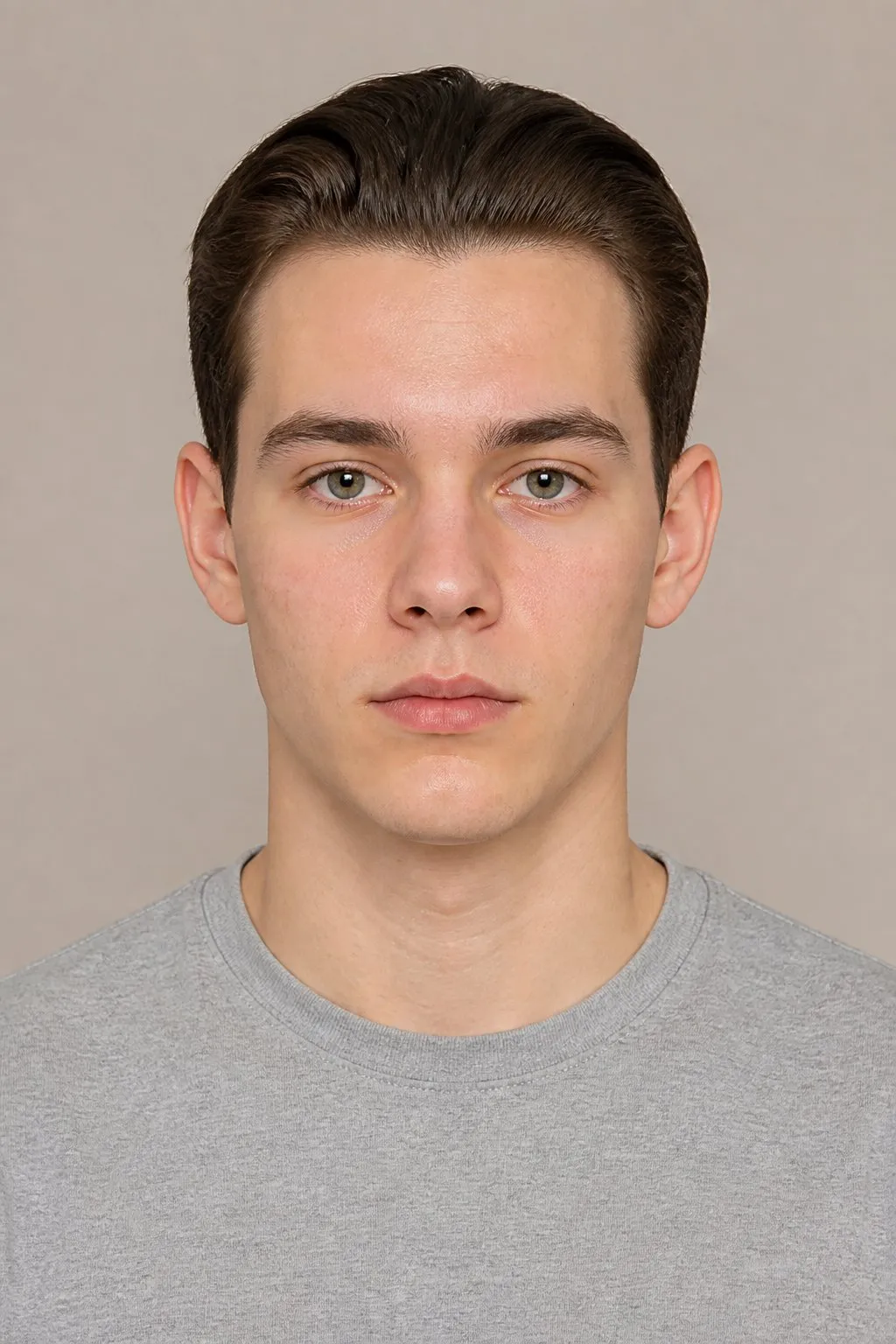
Twelve facial proportions from a single photo: facial width-to-height, midface, jaw and forehead against the cheekbones, eye and pupil spacing, and the nose, mouth and lip ratios.
Choose one clear, front-on photo
Looking at the camera, even light, hair off your forehead, no
glasses.
JPG, PNG or WebP up to 10 MB, or drag one here
Your photo never leaves your device.
Facial width-to-height (fWHR)
Add a photo and this fills in.
Face length to width
not yet
Jaw to cheekbone width
not yet
Forehead to cheekbone width
not yet
Pupil distance to face width
not yet %
Gap between eyes, in eye widths
not yet
Midface share of face length
not yet %
Lower face share of face length
not yet %
Mouth to face width
not yet %
Nose to mouth width
not yet
Nose length to face height
not yet
Lip height to mouth width
not yet
Typically 1.8 to 2.1 on this tool's anchors
Taking the measurement
1
Take a front-on photo
Square to the camera, hair back, neutral expression, even light.
2
Choose the file
Measured in your browser. Nothing is uploaded.
3
Use it as a baseline
The value of a set like this is comparing the same face over time, taken the same way, rather than comparing yourself to a number.
Example
Cheekbone width, over the height from the eyelid line to the upper lip.
Drawn from the landmarks our own measurement reads off this photo, not
placed by hand. It is a generated face, not a real person, and nothing
here is a verdict about it.
This measures twelve proportions from one photo: facial width-to-height, face length to width, jaw and forehead against the cheekbones, eye and pupil spacing, midface and lower-face shares, and the mouth, nose and lip proportions. Each is a ratio, so none depends on the size of your photo, and each prints the formula it used.
How this is worked out
Everything is a ratio
Each figure divides one measurement by another, so none depends on your photo's resolution or how far you stood from the camera. That is what makes two photos comparable at all.
Measured from 478 landmarks
One detection pass finds the points, and every ratio on this page is computed from the same set. So the numbers are internally consistent even where they are individually approximate.
No reference ranges unless they have a source
Most of these proportions have no population figure we could vet, so this page prints none. Where a range exists in the research it appears next to the measurement with its citation, and nowhere else.
What each measurement is
Reference bands are this tool's own, chosen for the landmarks it uses.
Where research reports a figure it is given separately, with the source,
because the two are different claims. And each one says what actually
moves it, which for most facial measurements is the more useful half.
Facial width-to-height (fWHR)
Formula
cheekbone width ÷ upper-face height (eyelid midpoint to upper lip)
Reference
1.8 to 2.1 on this tool's anchors
Research
published samples mostly fall between about 1.6 and 2.2, depending on the vertical anchor used (Geniole et al., 2015)
What moves it No attractiveness figure to aim at - the research links fWHR to how threatening a face reads, not how attractive. The skull is fixed; body fat over the cheeks is what moves the measured number.
Face length to width
Formula
face length ÷ cheekbone width
Reference
1.3 to 1.5 on this tool's anchors
What moves it Skeletal and fixed. Hair is the lever that changes how it reads - height on a long face, width on a short one.
Jaw to cheekbone width
Formula
jaw width ÷ cheekbone width
Reference
0.76 to 0.82 on this tool's anchors
Head turn, hair and camera distance all move this one.
What moves itBody fat. Facial fat sits over the jaw, and lowering it is what uncovers the width already there. The bone needs a surgeon.
Forehead to cheekbone width
Formula
forehead width ÷ cheekbone width
Reference
0.85 to 0.95 on this tool's anchors
Pupil distance to face width %
Formula
pupil-to-pupil distance ÷ cheekbone width
Reference
46% on this tool's anchors
Research
about 46% rated best - Pallett, Link & Lee (2010)
A photo proportion, not a millimetre pupillary distance for glasses.
What moves it 46% is a measured optimum and it is also fixed. Worth knowing as the figure the research converged on, not as something to work toward.
Gap between eyes, in eye widths
Formula
inner-eye gap ÷ average eye width
Reference
1.05 to 1.35 on this tool's anchors
Research
the one-eye-gap rule is a drawing convention; the five-fifths canon it comes from held in about 37% of faces (Farkas et al., 1985)
Midface share of face length %
Formula
brow line to nose base ÷ face length
Reference
38% to 44% on this tool's anchors
Other midface calculators use different anchors, so their numbers are not interchangeable with this one.
Lower face share of face length %
Formula
nose base to chin ÷ face length
Reference
36% to 42% on this tool's anchors
What moves it The proportion is skeletal. How the lower third photographs is not, and that tracks body fat - the one lever on this page worth a month.
Mouth to face width %
Formula
mouth-corner width ÷ cheekbone width
Reference
38% to 45% on this tool's anchors
Expression moves this. Keep the lips relaxed.
Nose to mouth width
Formula
nose-ala width ÷ mouth-corner width
Reference
0.72 to 0.86 on this tool's anchors
Nose length to face height
Formula
nose bridge to tip ÷ face length
Reference
0.20 to 0.24 on this tool's anchors
A front photo cannot measure projection. This is length only.
Lip height to mouth width
Formula
outer lip height ÷ mouth-corner width
Reference
0.25 to 0.40 on this tool's anchors
Smiling, pressing or pursing the lips all change it.
This measures twelve facial proportions from a single photo and reports them
together, each with the formula it used and the band it compares against.
It exists because measuring one ratio at a time means taking ten photos, and
because a set taken from one detection pass is internally consistent in a way
ten separate readings are not.
What you get
Facial width-to-height, cheekbone width over upper face height. The one with
the most research behind it, covered properly on the
FWHR calculator.
Face length to width, which is the ratio the golden-ratio claim is usually
built on.
Jaw and forehead against the cheekbones, the two that decide face shape.
Pupil distance and eye spacing, one as a share of face width and one in
eye-widths.
Midface and lower-face shares of total face length.
Mouth, nose and lip proportions: mouth against face width, nose against
mouth width, nose length against face height, and lip height against mouth
width.
Every one of them prints its formula and its reference band in the section
below, so you can see what was divided by what.
Two kinds of number, kept apart
Every measurement on this page prints a reference band and a formula.
Some also print a research line. The difference between the second and
third matters more than any individual figure.
Reference is this calculator’s own. It is the band we compare against for
these exact landmarks. It is not a universal ideal, not a population norm and
not a clinical threshold. Other tools measuring a similarly named ratio use
different anchors, which is why their numbers and ours disagree and why
comparing across tools is meaningless.
Research is what a published study reports, with the source named. Two rows
carry one. Pallett, Link and Lee found faces rated best with eye-to-mouth
distance near 36% of face length and pupils near 46% of face width, and
noted those are the proportions of an average face. Our
golden ratio calculator goes into that properly.
Merging the two would be the easy thing to do and it would imply our anchors
match a paper’s. They usually do not. Keeping them in separate lines is what
the evidence standards are for.
What these numbers are actually good for
Comparing one face with itself over time. Take the photo the same way, a
month apart, and the ratios involving soft tissue will move while the bone ones
will not. That is genuinely informative.
Comparing yourself to somebody else is mostly comparing cameras. Lens
distance changes facial proportions substantially, which is why a selfie
enlarges the nose. Two people photographed differently are not comparable, and
no amount of decimal places fixes that.
Where to go next
The facial thirds test covers the vertical proportions
in detail, including the 1985 study that found equal thirds are the exception.
The face shape detector turns the width ratios into a
category, and the attractiveness test shows how the
best-evidenced ones combine.
Proportions between two facial measurements, like width against height or jaw against cheekbone. Because they are ratios rather than distances, they stay comparable between photos taken at different sizes.
What is the midface ratio?
The share of your face length taken by the middle zone, from the brow line to the base of the nose. A longer midface is a description of proportion, not a defect.
What is a good eye spacing?
Pallett and colleagues found faces rated best when the pupils sat about 46% of face width apart. The striking part is what that corresponds to: an average face. So the best-rated spacing is the ordinary one, which is the opposite of how the golden ratio is usually sold.
What is the ideal facial ratio?
Every measurement here prints a reference band, and two of them have research behind them: faces rated best with eye-to-mouth distance at about 36% of face length and pupils about 46% of face width, from Pallett and colleagues. The rest are this calculator's own comparison bands for its own landmarks, which is a different and weaker kind of claim, and the page labels which is which.
Where do the reference bands come from?
They are this calculator's own, chosen for the landmarks it uses. They are not universal ideals, population norms or clinical thresholds, and similarly named ratios from other tools use different anchors and are not comparable. Where published research gives a figure it is shown separately, labelled as research, with the source.
What is fWHR?
Facial width-to-height ratio, cheekbone width over the height from the upper lip to the top of the eyelids. It predicts how threatening a face reads; the popular claim that it measures masculinity failed a 2017 meta-analysis.
Can I compare my ratios to someone else's?
Only loosely. Camera, lens and angle all shift these enough that a comparison between two people photographed differently is mostly comparing the photos.
Which of these ratios can I change?
The ones involving soft tissue move with body fat. Everything resting on bone spacing does not change in an adult.
Why do my ratios differ between photos?
Angle and lens. A phone close to your face enlarges what is nearest it, which is usually the nose, and a head turned slightly compresses one side.
Is this the same as a golden ratio calculator?
No. This reports proportions as measurements. The golden ratio tool compares your face to 1.618 and then explains what the research actually found instead.
Is my photo uploaded?
No. Everything runs in your browser and nothing is sent anywhere.
Measure how your face divides into upper, middle and lower thirds, and see the 1985 study that found equal thirds are the exception rather than the rule.
Find your face shape from a photo, measured from the real outline rather than guessed, with the runner-up shape and the three ratios behind the answer.
Open the tool
Join 7,800 subscribers
Email on appearance - what works, what the research says, and what people in the community are actually trying.
What works, what doesn't, and what the research says. Unsubscribe whenever
you want.