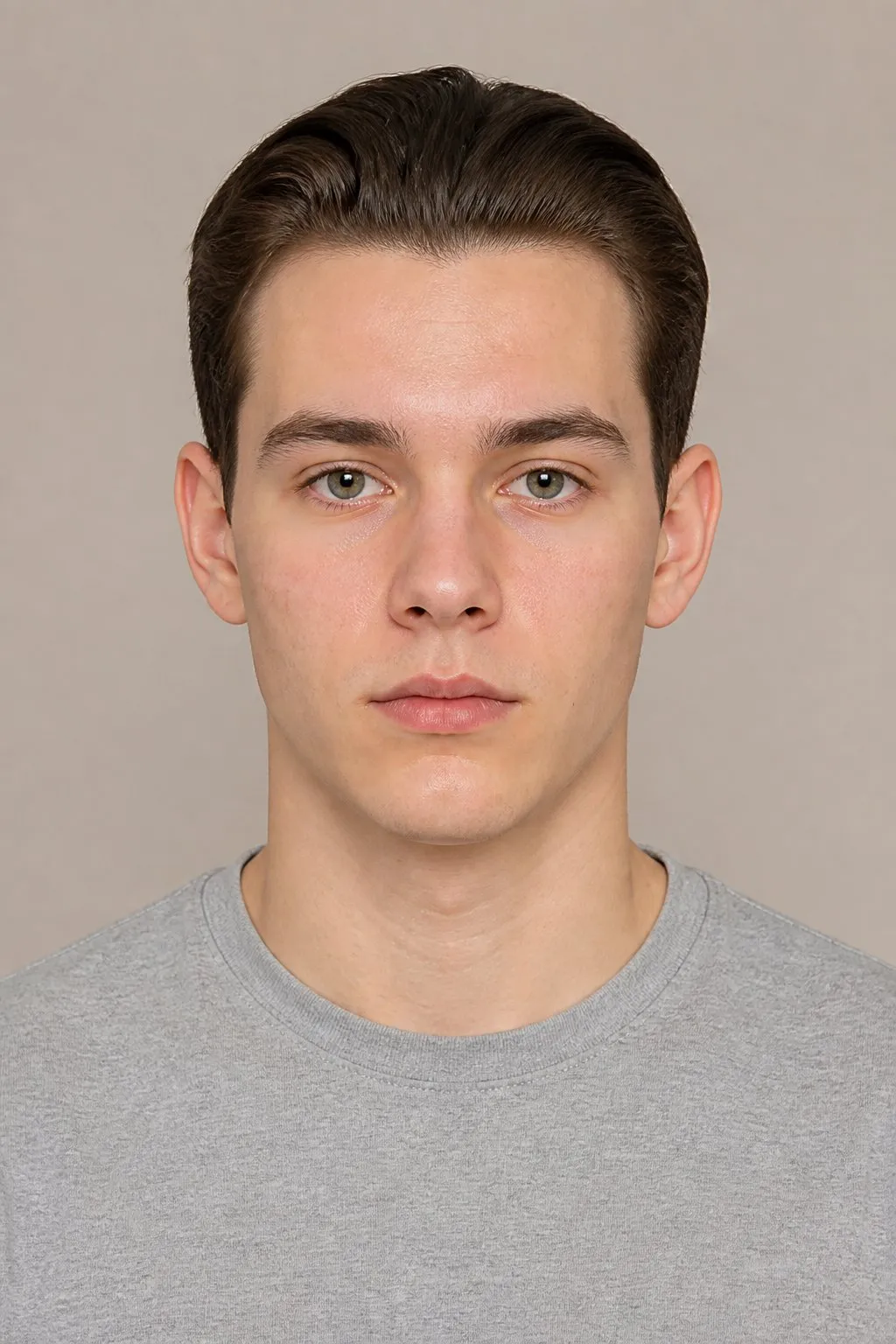
How your face divides into upper, middle and lower thirds, given as three percentages. Equal thirds are the classical ideal, and on real faces they are the exception.
Choose one clear, front-on photo
Looking at the camera, even light, hair off your forehead, no
glasses.
JPG, PNG or WebP up to 10 MB, or drag one here
Your photo never leaves your device.
How even the three are
/100
Add a photo and this fills in.
Distinctive below 44
Varies 44 to 58
Mixed 58 to 72
Close 72 to 85
Very close 85 to 100
Upper third
not yet %
Middle third
not yet %
Lower third
not yet %
Typically 100 would be three exactly equal thirds
Taking the measurement
1
Take a front-on photo
Square to the camera, chin level. Tilting the head changes every third.
2
Choose the file
Measured in your browser. Nothing is uploaded.
3
Read all three shares
The individual percentages tell you more than the evenness score, because they say which zone is long or short rather than just that something is.
Example
Hairline to brow, brow to nose base, nose base to chin.
Drawn from the landmarks our own measurement reads off this photo, not
placed by hand. It is a generated face, not a real person, and nothing
here is a verdict about it.
Facial thirds divide the face into three vertical zones: hairline to brow, brow to the base of the nose, and nose to chin. The classical canon says they should be equal. When 153 real faces were measured against that canon, the vertical proportions were the worst-fitting of the nine rules tested.
How this is worked out
Upper third
Top of the detected face outline down to the brow line. This is the forehead top rather than the hairline, because a hairline is hair and no landmark model can find one. On a receded hairline the two are far apart.
Middle third
Brow line down to the base of the nose.
Lower third
Base of the nose down to the bottom of the chin.
Evenness
How far the three sit from a perfectly even split, expressed out of 100. It is a distance from a convention, not a distance from an ideal, and the article below explains why that distinction matters here more than anywhere.
What each measurement is
Reference bands are this tool's own, chosen for the landmarks it uses.
Where research reports a figure it is given separately, with the source,
because the two are different claims. And each one says what actually
moves it, which for most facial measurements is the more useful half.
How even the three are /100
Formula
distance of the three thirds from an even 33.3% split
Reference
100 would be three exactly equal thirds
Research
the equal-thirds canon fits real faces poorly. Across 153 adults the vertical proportions were the worst-fitting of nine classical canons (Farkas et al., 1985)
Uneven thirds are the common case, not a defect.
What moves it The canon says 33.3% each, and Farkas showed most faces miss it - so evenness is a reference rather than something to chase. The proportions themselves are skeletal and do not move without surgery. What does move is how the lower third photographs, which tracks body fat, and that is the only lever on this page worth a month of anybody's effort.
Upper third %
Formula
top of face mesh to brow line ÷ face length
Measured to the top of the forehead, not the hairline. On a receded hairline this reads short.
Middle third %
Formula
brow line to nose base ÷ face length
Lower third %
Formula
nose base to chin ÷ face length
This measures how your face divides into three vertical zones and reports each
as a share of total face length.
The interesting part is not your numbers. It is what happened when somebody
measured everybody else’s.
The canon, and the study that tested it
The rule that a face divides into three equal parts comes from Renaissance
drawing instruction. It was a teaching convention for artists, which is a
different thing from a description of human faces, and it drifted into
aesthetics as though it were the second.
In 1985, Farkas and colleagues published a test of nine of these classical
canons against measurements of 153 young adults in Plastic and Reconstructive
Surgery.
The two that held most often were both horizontal: interorbital width equal to
nose width in 40% of faces, and nose width a quarter of face width in
37%. The vertical profile proportions, which include the equal thirds,
fared worst of the nine.
Their conclusion is the line worth keeping: the canons do not represent average
facial proportions, and interpreting them as a prescription for an ideal has to
be tested rather than assumed.
So if your thirds come back uneven, you have found the normal case. One
population, one study, 1985, and it is still the only honest thing on the first
page of results for this search.
What the measurement here actually covers
The upper third is approximate, and the reason is structural. It runs from
the top of the detected face outline, which is the upper forehead, not the
hairline. A landmark model finds faces; a hairline is hair. On a receded or
shaved hairline these are far apart, and the upper third will read short.
The middle and lower thirds are firmer. Brow line to nose base, and nose
base to chin, are all points the mesh places directly.
Head tilt moves everything. Raising your chin lengthens the lower third and
shortens the upper. If you are comparing two photos, hold your head the same
way in both.
What this does not mean
The canon’s number is 33.3% each, and now you know how rarely real faces meet
it. Farkas himself declined to read the canons as a prescription, which is the
most useful sentence in the paper.
The proportions that do have an experiment behind them are different ones, and
they are on the golden ratio calculator: Pallett and
colleagues found eye-to-mouth spacing near 36% of face length rated best, and
noted those are the proportions of an average face.
Where to go next
The facial ratios calculator reports these thirds
alongside eleven others from the same photo. The
attractiveness test shows how vertical balance
combines with the better-evidenced components, and why it is worth only 15
points there.
Three vertical zones of the face: hairline to brow, brow to the base of the nose, and nose to chin. The idea comes from Renaissance drawing convention, where they were taught as equal.
Should facial thirds be equal?
The canon says yes. The measurements say most faces are not like that. In 1985 Farkas and colleagues tested nine classical canons against 153 young adults and the vertical proportions fared worst of all of them.
What does an uneven facial third mean?
That you have an ordinary face. Uneven thirds are the common case, not a defect, and the study that measured it is the citation on this page.
What is a long lower third?
A lower third taking more than its even share of face length. It is a description of proportion, and it is also the zone most affected by how you held your chin when the photo was taken.
Why does this measure from the forehead and not the hairline?
Because a hairline is hair, and a facial landmark model finds faces. The mesh stops at the top of the face outline. On a receded or shaved hairline the difference is substantial, so treat the upper third here as approximate.
Can you change your facial thirds?
Not without surgery, and that is an adult decision for a qualified surgeon with real risks attached. What does change is how the lower third photographs, which tracks body fat and jaw definition.
What is the ideal facial third ratio?
The classical canon says three equal thirds, 33.3% each. Farkas measured 153 adults against nine such canons and the vertical proportions were the worst-fitting of all of them, concluding they do not represent average facial proportions. So the canon has a number and real faces mostly do not meet it.
Do facial thirds affect attractiveness?
Our attractiveness test includes vertical balance but weights it at only 15%, and the reason is this study. A canon that most real faces fail is weak ground for a scoring component.
Why did my thirds change between photos?
Head tilt, mostly. Raising or lowering your chin lengthens one zone and shortens another, and it is the single easiest way to get a different answer from the same face.
Is my photo uploaded?
No. Everything runs in your browser and the site's content security policy blocks connections to any other domain.