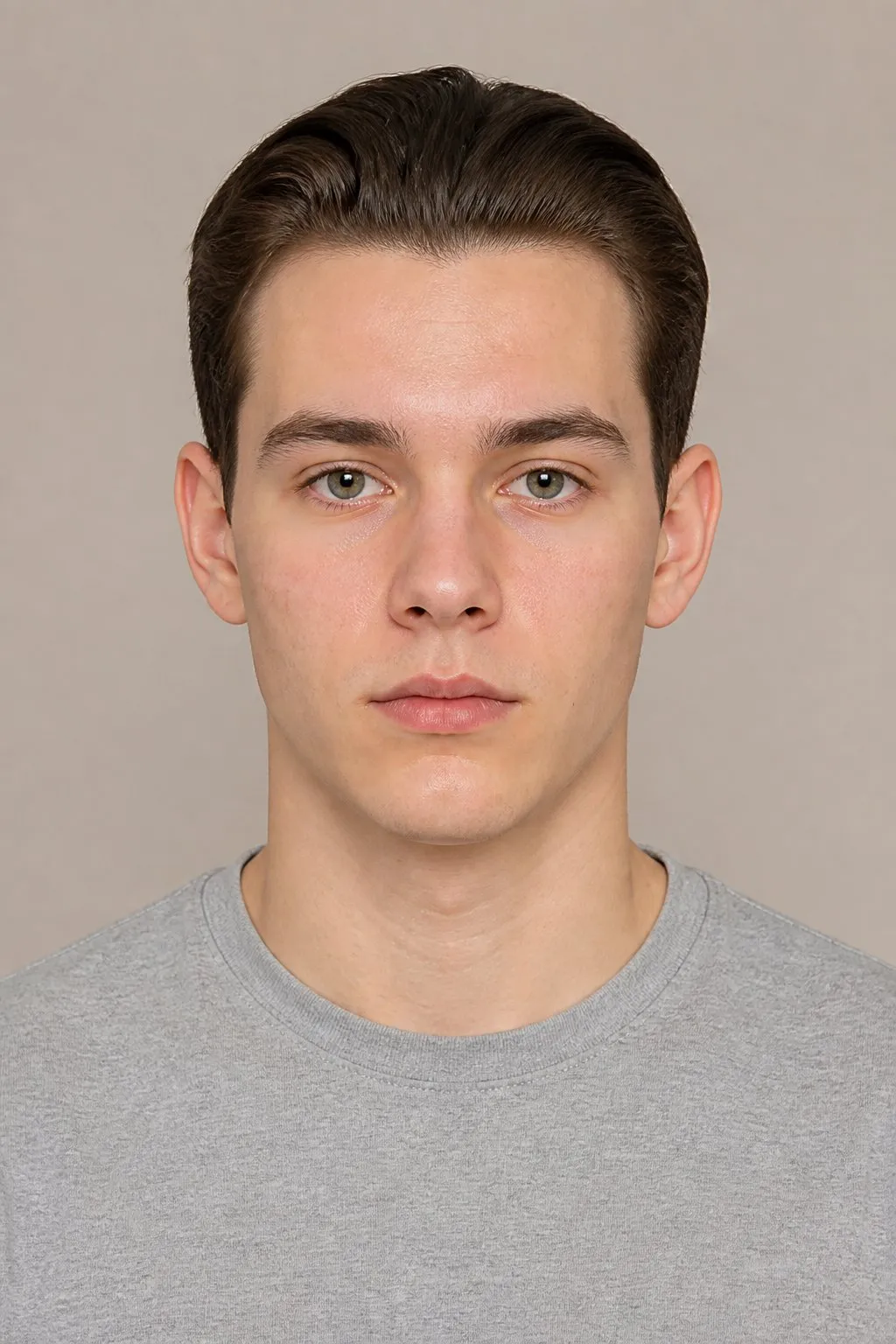
A definition score out of 100 for your jaw, built from the gonial angle, your jaw width against your cheekbone width, and how much of your face length the lower third takes.
Choose one clear, front-on photo
Looking at the camera, even light, hair off your forehead, no
glasses.
JPG, PNG or WebP up to 10 MB, or drag one here
Your photo never leaves your device.
Jaw definition
/100
Add a photo and this fills in.
Distinctive below 44
Varies 44 to 58
Mixed 58 to 72
Close 72 to 85
Very close 85 to 100
Gonial angle
not yet °
Jaw to cheekbone width
not yet
Lower face share of face length
not yet %
Typically 0 to 100 against this tool's three components
Taking the measurement
1
Take a front-on photo
Square to the camera with your chin level and your mouth closed. A raised chin flatters the jaw and changes all three measurements.
2
Choose the file
Measured in your browser. Nothing is uploaded.
3
Read the parts
The gonial angle is structural and the lower-face proportion is fixed. Only how sharply they read changes, and that is mostly body fat.
Example
The angle at the corner of the jaw.
Drawn from the landmarks our own measurement reads off this photo, not
placed by hand. It is a generated face, not a real person, and nothing
here is a verdict about it.
This measures three things from a photo: the gonial angle at the corner of your jaw, your jaw width against your cheekbone width, and how much of your face length the lower third takes. Those combine into a definition score out of 100, with each part shown separately.
How this is worked out
Gonial angle
The angle at the corner of the jaw, between the line running up toward the ear and the line running forward to the chin. A sharper angle reads as a more defined jaw in a front-on photo.
Jaw to cheekbone width
How square the lower face is. This is what separates a jaw that reads strong from one that tapers.
Lower-face proportion
The share of face length below the nose. Included because a jaw reads partly in relation to the face above it rather than on its own.
What each measurement is
Reference bands are this tool's own, chosen for the landmarks it uses.
Where research reports a figure it is given separately, with the source,
because the two are different claims. And each one says what actually
moves it, which for most facial measurements is the more useful half.
Jaw definition /100
Formula
equal weighting of the three measurements below
Reference
0 to 100 against this tool's three components
Describes this photo. Chin position alone moves all three inputs at once.
What moves itBody fat, first and by a distance. Facial fat sits over the jaw and lowering total body fat is what uncovers the structure already there - it is the one lever here that shows in weeks. Posture and sleep help at the margins. Jaw exercisers do not work the way they are sold: they thicken the masseter, which widens the lower face. Mewing is a posture habit with weak evidence for adult bone change. The bone itself needs a surgeon, as an adult.
Gonial angle °
Formula
angle at the jaw corner, averaged across both sides
Reference
120° to 130° on this tool's anchors
Research
adult males average 124° and females 122° on cephalograms - Riolo et al. (1974)
What moves it Bone. Nothing non-surgical changes it, and chewing devices widen the lower face rather than sharpening it.
Jaw to cheekbone width
Formula
jaw width ÷ cheekbone width
Reference
0.76 to 0.82 on this tool's anchors
What separates a jaw that reads square from one that tapers.
What moves itBody fat, which sits over the jaw and hides the width already there.
Lower face share of face length %
Formula
nose base to chin ÷ face length
Reference
36% to 42% on this tool's anchors
What moves it Skeletal proportion, fixed. How it photographs is not.
This scores jaw definition from three measurements taken off a front-on photo:
the gonial angle, jaw width against cheekbone width, and the lower-face
proportion.
Each is shown separately, because the combined number hides the only useful
question, which is whether the thing holding your score down is something that
moves.
What each part is doing
The gonial angle is the corner of the jaw, between the branch running up
toward the ear and the branch running forward to the chin. A sharper angle reads
as a more defined jaw.
Jaw to cheekbone width is what separates a jaw that reads square from one
that tapers.
Lower-face proportion is the share of face length below the nose. A jaw
reads partly in relation to the face above it, not on its own.
The measurement’s real limit
A true gonial angle is measured from the side, and ideally from an X-ray.
This is a front-on approximation from surface landmarks, and it is systematically
less reliable than a lateral cephalogram would be.
We would rather say that than report a figure to one decimal and let it look
clinical. If the number matters to you at that level, an orthodontist with
imaging is the answer, not a web page.
What actually changes a jawline
This is the section most pages on this query get wrong, so it is worth being
direct.
Body fat, first and by a wide margin. Facial fat sits over the jaw, and
lowering total body fat is what uncovers the structure that is already there. It
works, it is well evidenced as a mechanism, and it is the only one of these
levers that produces a visible change in weeks. The
body fat estimate gives you something to track.
Posture and fluid. A forward head position hides the jaw line, and a bad
night’s sleep puffs the lower face. Both are real and both are small.
Not jaw exercisers. There is no good evidence that chewing devices reshape
an adult jaw. They load the masseter, which can thicken with use, and a thicker
masseter widens the face rather than sharpening it. That is the opposite of what
the product is sold for.
Not mewing, for the bone. Mewing is a tongue posture habit. The evidence for
adult bone remodelling from it is weak. Tongue posture is still worth building
for breathing and swallowing reasons, and both of those sentences are true at
the same time.
The bone itself does not change. Genioplasty and jaw surgery exist, they are
adult decisions for a qualified maxillofacial surgeon, and they carry real risk
and a long recovery.
On wide jaws and masculinity
The assumption that a wider lower face reads as more masculine is weaker than
its confidence suggests. The closest tested version of that claim is the
facial width-to-height ratio, and a 2017 meta-analysis found little evidence of
a reliable sex difference once skull samples were excluded. Our
FWHR calculator covers that properly.
Where to go next
The gonial angle tool measures the angle on its own with
both sides reported. The face shape detector uses the same
outline, and a square reading there rests on the same jaw-to-cheekbone ratio
scored here.
From a front-on photo, using the angle at the jaw corner and the jaw's width against the cheekbones. A true gonial angle is measured from a side profile or an X-ray, so a front-on figure is an approximation.
What is a good jawline score?
The score averages how close three measurements sit to this tool's reference bands: a gonial angle of 120 to 130 degrees, a jaw-to-cheekbone ratio of 0.76 to 0.82, and a lower face taking 36 to 42% of face length. It describes this photograph. No research establishes a jawline figure anyone should reach.
How do I get a more defined jawline?
Body fat, first and by a distance. Facial fat sits over the jaw and lowering total body fat is what uncovers it. Posture and reducing fluid retention help at the margins. The bone underneath does not change.
Do jaw exercisers work?
There is no good evidence that chewing devices reshape an adult jaw. They work the masseter, which can thicken with use, and that widens the face rather than sharpening it. The gadget market runs on this confusion.
Does mewing change your jawline?
Mewing is a tongue posture habit. The evidence for adult bone remodelling from it is weak. Good tongue posture is still worth building for other reasons, and both of those things are true at once.
What is a gonial angle?
The angle at the corner of the jaw, where the vertical branch of the mandible meets the horizontal one. Our gonial angle tool covers it in more detail than the score here does.
Can you change your gonial angle?
Not without surgery, which is an adult decision for a qualified maxillofacial surgeon with real risks and a long recovery. Nothing non-surgical changes the angle of the bone.
Why did my score change between photos?
Chin position, mostly. Raising your chin flatters the jaw and changes all three inputs at once, which is why every photo of a jawline online is taken that way.
Does a wide jaw mean a masculine face?
That assumption is weaker than it sounds. The closest tested version, the facial width-to-height ratio, failed to show a reliable sex difference in a 2017 meta-analysis once skull samples were removed.
Is my photo uploaded?
No. Everything is measured in your browser and nothing is sent anywhere.
Find your face shape from a photo, measured from the real outline rather than guessed, with the runner-up shape and the three ratios behind the answer.